Gill-Morris Farm

Why it's listed
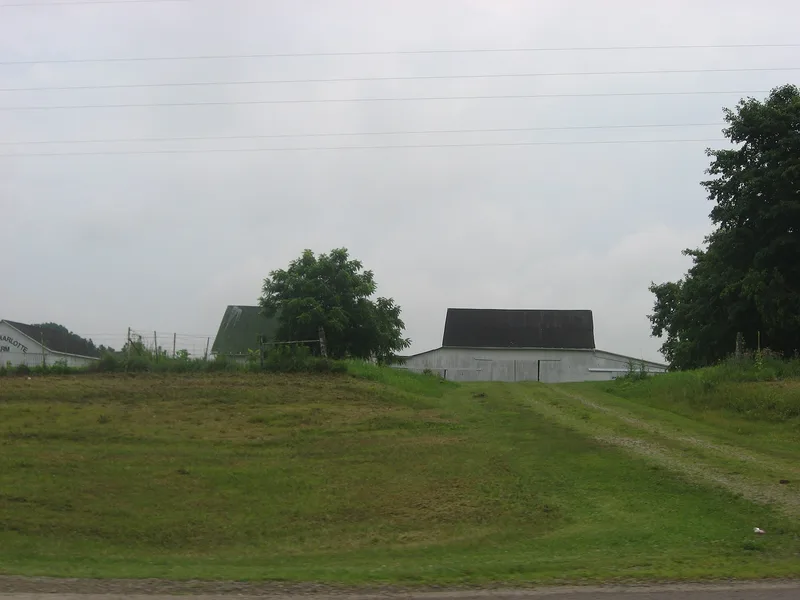
Near Circleville, this 150-acre farm in Pickaway County holds a brick farmhouse built in two stages, about 1820 and about 1832. The older rear wing has Flemish bond brickwork and bull's-eye lintels, while the larger main block has a central hall plan, bridged chimneys, walnut woodwork and original hardware. Together they show the change from Federal to Greek Revival design. An original drover's room recalls the farm's role in the Scioto Valley cattle trade, when Shorthorn cattle were raised here before being driven east. Historic outbuildings include implement sheds, a three-bay ground barn and a transverse corn crib. The land is also tied to Camp Charlotte, where Lord Dunmore and Chief Cornstalk made peace in 1774, and a monument to the treaty stands in front of the house. The farm descends from the Winship family tract and has kept its boundaries since the 1830s.
Significance in brief: The farmhouse is argued to be an early, little-altered farmhouse showing the shift from Federal to Greek Revival style. The farm has also stayed intact since the 1830s and took part in the Scioto Valley cattle industry. It is also linked to the 1774 Camp Charlotte peace treaty between Lord Dunmore and Chief Cornstalk.
Machine-generated summary. This summary was generated by a language model from the official nomination document and has not been reviewed line by line by an editor. It may contain errors. Check the source document before relying on any detail. Source: nomination document (PDF) · National Archives catalog entry. NRHP reference 86001658, listed August 14, 1986. Summary generated October 2026 (model claude-sonnet-5-5, prompt v1.0-2026-10-29, confidence high).
Key facts
| Address | 10104 OH 56, Circleville |
|---|---|
| County | Pickaway County |
| Listed | August 14, 1986 |
| Reference number | 86001658 |
| Resource type | Building |
| Architectural style | Federal and Greek Revival |
| Criteria |
|
| Areas of significance | Architecture |
| Level of significance | Local |
| Status (as stated in the nomination) | Listed as occupied, in excellent condition and used for agriculture and as a private residence; the land is leased for farming and grazing. |
| Acreage | 150 |
| Coordinates | 39.53904, -82.84372 (NPS GIS) |
What listing means for this property
National Register listing is honorary for a privately owned home: it does not by itself restrict what an owner may do with their own money, and it does not require public access. Restrictions come from local landmark or historic-district ordinances, which are separate (how they differ).
Owner-occupied houses are not eligible for the 20% federal rehabilitation tax credit, which applies to income-producing buildings, but many states offer credits for homeowners. Listing also opens the door to preservation easements and to buying a plaque. Start with what listing means for homeowners, renovating a listed house and selling one.
General information, not legal or tax advice. Rules change; confirm with your State Historic Preservation Office or a qualified adviser.
Sources and further reading
- National Park Service, National Register of Historic Places database (snapshot May 2026), reference 86001658.
- Nomination form (PDF, National Archives) — catalog entry
- Wikipedia article (used for cross-checking only; text not reproduced here)
- Wikidata Q14716422
- This listing as JSON
Last updated October 2026. Found an error? See the editorial policy for how to report it.