Perry's Victory and International Peace Memorial

Why it's listed
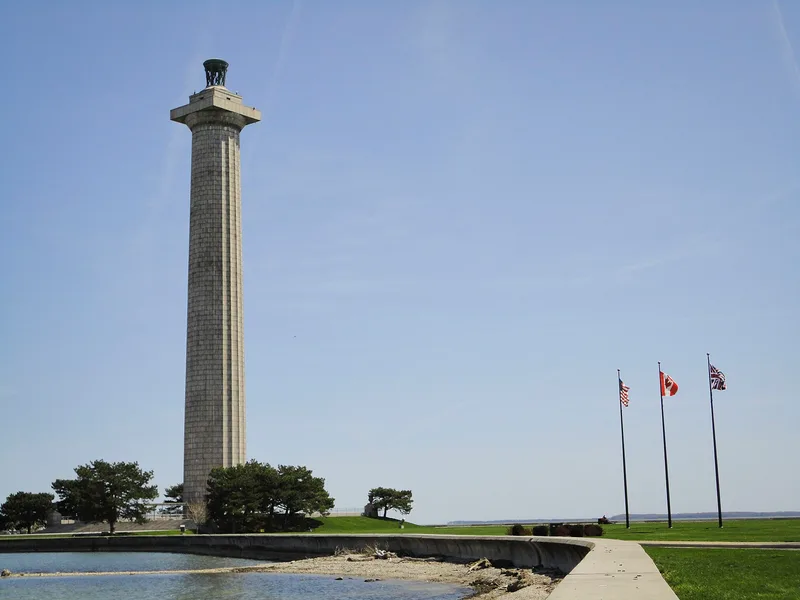
Rising 352 feet above the shore of Put-in-Bay on South Bass Island, this Greek Doric column of pink Massachusetts granite is described as the most massive Doric column ever built. It opened to the public on June 13, 1915, and an elevator carries visitors to an observation platform beneath a bronze urn. The rotunda at its base lists American vessels and the dead and wounded of the Battle of Lake Erie, and a crypt holds six officers killed there in 1813. A bronze tablet records the Rush-Bagot Agreement of 1817. The memorial recalls Commodore Perry's victory over a British squadron, which gave the Americans control of Lake Erie and influenced the peace negotiations that ended the War of 1812. Joseph H. Freedlander and A. D. Seymour designed it after a major architectural competition, though only the column and terraces were built. The nomination stresses its scale, its engineering and its historical associations, and says the surrounding grounds should remain free of new construction.
Significance in brief: It commemorates the Battle of Lake Erie of September 10, 1813, in which Commodore Oliver Hazard Perry defeated a British squadron, and the Rush-Bagot Agreement of 1817, which began disarmament of the U.S.-Canada border. The nomination also values its enormous scale and the engineering achievement of its construction for 1913-1915. It holds the remains of three American and three British officers killed in the battle.
Machine-generated summary. This summary was generated by a language model from the official nomination document and has not been reviewed line by line by an editor. It may contain errors. Check the source document before relying on any detail. Source: nomination document (PDF) · National Archives catalog entry. NRHP reference 66000118, listed October 15, 1966. Summary generated October 2026 (model claude-sonnet-5-5, prompt v1.0-2026-10-29, confidence high).
Key facts
| Address | South Bass Island, Put-in-Bay |
|---|---|
| County | Ottawa County |
| Listed | October 15, 1966 |
| Reference number | 66000118 |
| Resource type | Structure |
| Period of significance | 1800-1899, 1900- (specific dates 1913, 1915, 1926, 1931) |
| Architect / builder | Freedlander and Seymour |
| Architectural style | Greek Doric fluted column |
| Areas of significance | Military, Engineering |
| Level of significance | National |
| Status (as stated in the nomination) | Occupied and publicly accessible as a park. The column has had no major rehabilitation since construction, the terraces are badly deteriorated, and storms in 1972 and 1973 destroyed most of the south seawall. Rehabilitation investigations were underway. |
| Acreage | 12.1 |
| Coordinates | 41.65375, -82.81154 (NPS GIS) |
What listing means for this property
For a publicly owned building or structure, listing mainly matters when federal funds, permits or licences are involved: projects then go through Section 106 review so effects on the property are considered. Listing also strengthens applications for preservation grants and, for leased income-producing uses, can enable the federal rehabilitation tax credit.
General information, not legal or tax advice. Rules change; confirm with your State Historic Preservation Office or a qualified adviser.
Sources and further reading
- National Park Service, National Register of Historic Places database (snapshot May 2026), reference 66000118.
- Nomination form (PDF, National Archives) — catalog entry
- Wikipedia article (used for cross-checking only; text not reproduced here)
- Wikidata Q2071814
- This listing as JSON
Last updated October 2026. Found an error? See the editorial policy for how to report it.