Williams, Abner, Log House
Also known as: Mr. and Mrs. W.D. Neffs House

Why it's listed
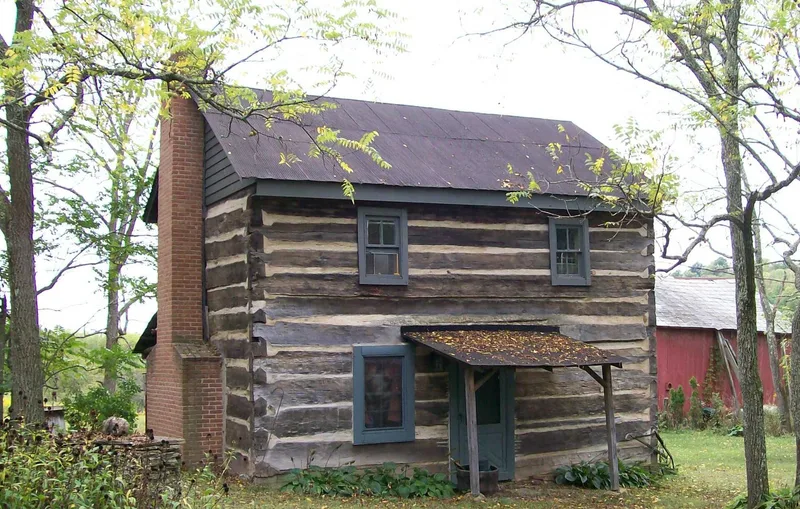
This two-story hewn log house with a loft stands northeast of Lashley in Noble County, Ohio, at the corner of State Route 761 and Township Road 166. Abner Williams bought the land in 1827 and settled there, and the house dates to about that year. It has a stone foundation, steeple-notched corners, a gabled roof now covered in corrugated metal, and a steep enclosed winding stair. A rear lean-to remains, while a kitchen addition was removed around 1930. A two-story frame barn is the only surviving outbuilding. The house is considered a representative example of log building from the second quarter of the 19th century, in an area along the Muskingum River drainage known for log architecture. Its survival matters in a region heavily affected by strip mining. Williams came from a Quaker family of early settlers, farmed up to 292 acres, and served as one of the first Justices of the Peace of Wayne Township. His son Thomas served in the state legislature. Tenant farmers lived in the house until 1925.
Significance in brief: It is nominated as a representative example of hewn log architecture from the second quarter of the 19th century in Ohio, in a region where strip mining has destroyed much historic fabric. It is also tied to the Williams family, Quaker early settlers, and to Abner Williams, a successful farmer and one of the first Justices of the Peace of Wayne Township.
Machine-generated summary. This summary was generated by a language model from the official nomination document and has not been reviewed line by line by an editor. It may contain errors. Check the source document before relying on any detail. Source: nomination document (PDF) · National Archives catalog entry. NRHP reference 79001923, listed June 20, 1979. Summary generated October 2026 (model claude-sonnet-5-5, prompt v1.0-2026-10-29, confidence high).
Key facts
| Address | NE of Lashley, Lashley |
|---|---|
| County | Noble County |
| Listed | June 20, 1979 |
| Reference number | 79001923 |
| Resource type | Building |
| Period of significance | c. 1827 |
| Architect / builder | Abner Williams |
| Architectural style | Hewn log construction, typical of the second quarter of the 19th century in Ohio |
| Areas of significance | Exploration/Settlement, Politics/Government, Architecture |
| Level of significance | Local |
| Status (as stated in the nomination) | Listed as vacant. The house was occupied by tenant farmers until 1925 and then remained unoccupied. Condition is marked fair, and the barn is in good condition. |
| Acreage | 3 |
| Coordinates | 39.94629, -81.36037 (NPS GIS) |
What listing means for this property
National Register listing is honorary for a privately owned home: it does not by itself restrict what an owner may do with their own money, and it does not require public access. Restrictions come from local landmark or historic-district ordinances, which are separate (how they differ).
Owner-occupied houses are not eligible for the 20% federal rehabilitation tax credit, which applies to income-producing buildings, but many states offer credits for homeowners. Listing also opens the door to preservation easements and to buying a plaque. Start with what listing means for homeowners, renovating a listed house and selling one.
Noted as vacant in the nomination. Nomination documents can be decades old; current status may differ. If you are considering buying an empty listed property, read the due-diligence checklist.
General information, not legal or tax advice. Rules change; confirm with your State Historic Preservation Office or a qualified adviser.
Sources and further reading
- National Park Service, National Register of Historic Places database (snapshot May 2026), reference 79001923.
- Nomination form (PDF, National Archives) — catalog entry
- Wikipedia article (used for cross-checking only; text not reproduced here)
- Wikidata Q4668161
- This listing as JSON
Last updated October 2026. Found an error? See the editorial policy for how to report it.