Levering Hall

Why it's listed
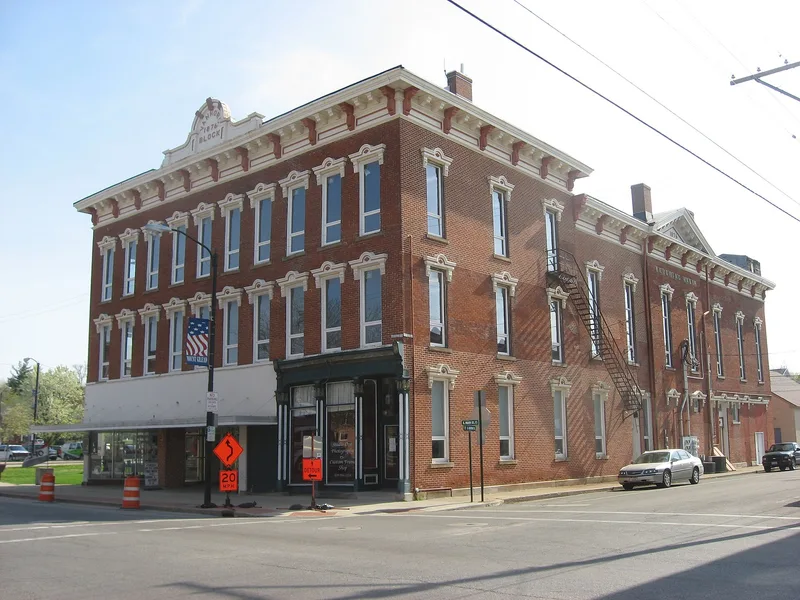
Levering Hall is a three-story brick building in downtown Mount Gilead, Ohio, occupying a full block facing the public square. Built in 1876 as part of the local centennial spirit, it combines a ten-bay front commercial block, known as the Van Horn Block, with a rear section that housed the town hall and fire station. Italianate features include brackets, ornate metal lintels, cast iron columns and a large nameplate above the cornice. Upstairs, a lobby with a ticket booth leads to a two-story opera hall with a stage, which hosted plays and productions until about 1950. William Miller, an experienced contractor who built several county courthouses, was the builder. The hall was named for Allen Levering, a local banker who later became a state legislator. It is considered significant as Mount Gilead's first major Italianate commercial building, its largest, and a rare combination of public offices, businesses and entertainment space. A local theater group planned restoration of the opera hall.
Significance in brief: It is presented as a prime example of Italianate commercial architecture and a major visual landmark in Mount Gilead. It was Mount Gilead's first major Italianate commercial building and the largest in town. It combined town offices, a fire station, shops and an opera hall under one roof, which the form says no other North Central Ohio community did.
Machine-generated summary. This summary was generated by a language model from the official nomination document and has not been reviewed line by line by an editor. It may contain errors. Check the source document before relying on any detail. Source: nomination document (PDF) · National Archives catalog entry. NRHP reference 80003180, listed May 29, 1980. Summary generated October 2026 (model claude-sonnet-5-5, prompt v1.0-2026-10-29, confidence high).
Key facts
| Address | 12 S. Main St., Mount Gilead |
|---|---|
| County | Morrow County |
| Listed | May 29, 1980 |
| Reference number | 80003180 |
| Resource type | Building |
| Period of significance | 1800-1899 |
| Architect / builder | William Miller (Miller and Smith, builders) |
| Architectural style | Italianate |
| Areas of significance | Entertainment/Recreation, Politics/Government, Architecture |
| Level of significance | Local |
| Status (as stated in the nomination) | Occupied; ground floor holds a department store, while the upper floors suffered about thirty years of neglect and a restoration effort was underway, led by a local theatrical group. |
| Acreage | 0.9 |
| Coordinates | 40.54880, -82.82802 (NPS GIS) |
What listing means for this property
National Register listing is honorary for a privately owned home: it does not by itself restrict what an owner may do with their own money, and it does not require public access. Restrictions come from local landmark or historic-district ordinances, which are separate (how they differ).
Owner-occupied houses are not eligible for the 20% federal rehabilitation tax credit, which applies to income-producing buildings, but many states offer credits for homeowners. Listing also opens the door to preservation easements and to buying a plaque. Start with what listing means for homeowners, renovating a listed house and selling one.
General information, not legal or tax advice. Rules change; confirm with your State Historic Preservation Office or a qualified adviser.
Sources and further reading
- National Park Service, National Register of Historic Places database (snapshot May 2026), reference 80003180.
- Nomination form (PDF, National Archives) — catalog entry
- Wikipedia article (used for cross-checking only; text not reproduced here)
- Wikidata Q6535303
- This listing as JSON
Last updated October 2026. Found an error? See the editorial policy for how to report it.