Starr, Horace C., House and Carriage Barns

Why it's listed
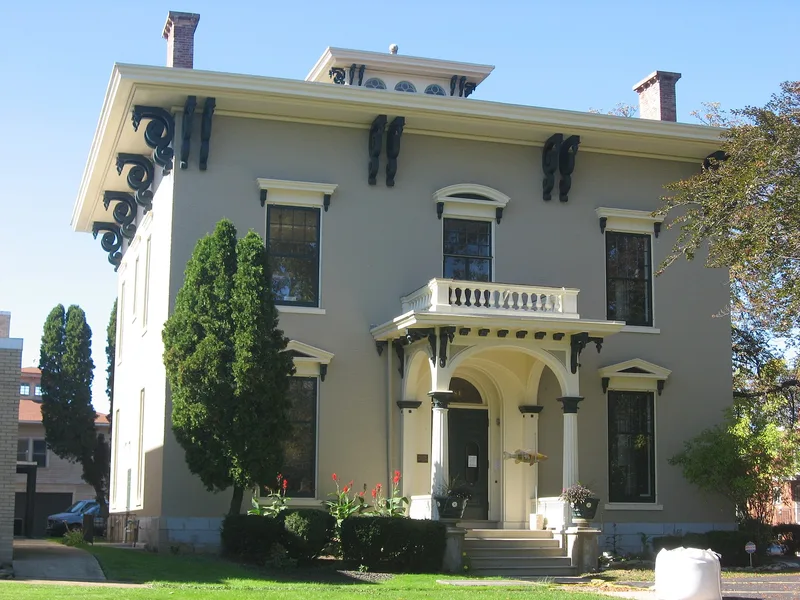
Built in 1857, this two-story brick house at 276 Washington Avenue in Elyria was designed in the Italianate style and is credited to a builder named Mr. Bagg. A square wooden cupola with rounded windows crowns the roof, large paired wooden brackets line the eaves, and stamped metal pediments top the windows. An entrance porch with Corinthian columns marks the front door. Two square carriage barns, one of wood and one of brick, remain on the grounds. The house was built for Horace C. Starr, a dry goods merchant who prospered in Elyria and helped build the Commercial Block downtown after an 1873 fire. Its listing rests chiefly on architecture: it is among the earliest Italianate buildings in the city and uses mass-produced metal and plaster details. It is also the last of the Civil War era mansions that once lined Washington Avenue. A later church building was added against the house, and the first floor was converted to classrooms.
Significance in brief: The nomination argues the house is significant mainly for its architecture, as a well-executed Italianate building and one of the first of that style in Elyria, when Greek Revival buildings were still being built. It also uses mass-produced elements such as metal window lintels and plaster interior ornament. It is the last of the grand Civil War era mansions that once lined Washington Avenue.
Machine-generated summary. This summary was generated by a language model from the official nomination document and has not been reviewed line by line by an editor. It may contain errors. Check the source document before relying on any detail. Source: nomination document (PDF) · National Archives catalog entry. NRHP reference 79001885, listed April 3, 1979. Summary generated October 2026 (model claude-sonnet-5-5, prompt v1.0-2026-10-29, confidence medium).
Key facts
| Address | 276 Washington Ave., Elyria |
|---|---|
| County | Lorain County |
| Listed | April 3, 1979 |
| Reference number | 79001885 |
| Resource type | Building |
| Period of significance | 1857 |
| Architect / builder | Mr. Bagg |
| Architectural style | Italianate |
| Areas of significance | Architecture, Social History |
| Level of significance | Local |
| Status (as stated in the nomination) | Occupied and in fair condition, with some alterations. Owned by a church that uses the house for classrooms. Modern church walls were built directly against the house, and the church was reported to be seeking a new site. |
| Acreage | 1 |
| Coordinates | 41.37121, -82.10688 (NPS GIS) |
What listing means for this property
National Register listing is honorary for a privately owned home: it does not by itself restrict what an owner may do with their own money, and it does not require public access. Restrictions come from local landmark or historic-district ordinances, which are separate (how they differ).
Owner-occupied houses are not eligible for the 20% federal rehabilitation tax credit, which applies to income-producing buildings, but many states offer credits for homeowners. Listing also opens the door to preservation easements and to buying a plaque. Start with what listing means for homeowners, renovating a listed house and selling one.
General information, not legal or tax advice. Rules change; confirm with your State Historic Preservation Office or a qualified adviser.
Sources and further reading
- National Park Service, National Register of Historic Places database (snapshot May 2026), reference 79001885.
- Nomination form (PDF, National Archives) — catalog entry
- Wikidata Q138497262
- This listing as JSON
Last updated October 2026. Found an error? See the editorial policy for how to report it.