Marmon, Martin, House
Also known as: Springate

Approximate location: the National Park Service places this pin arbitrarily within the property, not at a surveyed point (stated accuracy ±12 m).
Why it's listed
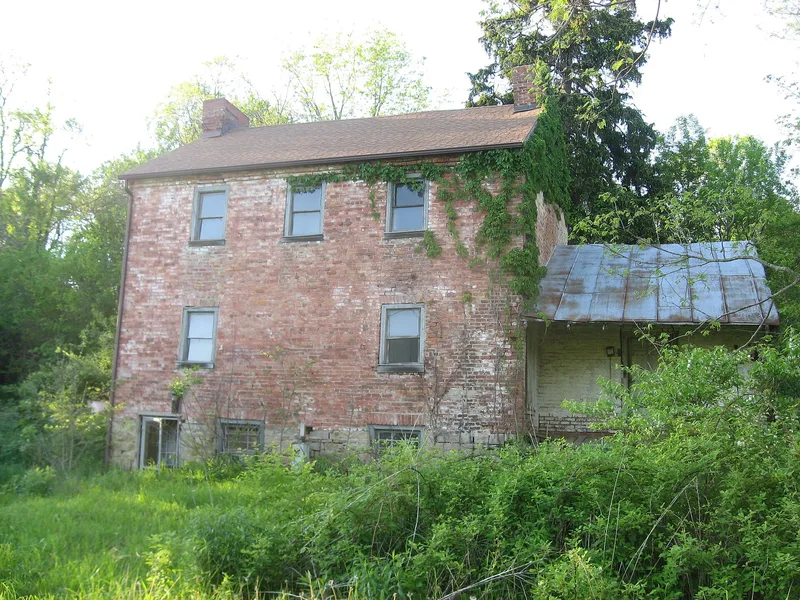
Built around 1820 east of Zanesfield in Logan County, Ohio, this brick house was the home of Martin Marmon, who came from North Carolina in 1805 with his brothers to found a Quaker community. The family helped establish the Goshen Meeting in 1807. Marmon later served as township and county treasurer and as sheriff. The house has a symmetrical three-bay facade laid in Flemish bond, a gable roof, and large end chimneys. Inside, the three-room plan follows the Quaker arrangement, with a large room heated by a gable-wall fireplace and smaller rooms served by corner fireplaces sharing one chimney. Federal-style fluted mantels, floors, doors and cupboards appear original. A one-story brick wing and a tin-roofed animal shed are also part of the listed property. Other Quaker houses in the area were demolished, ruined or heavily altered, which leaves this one as the purest surviving example of its type in west-central Ohio.
Significance in brief: The house marks the 1805 Quaker settlement of the Marmon Valley, the denomination's northernmost settlement in the Virginia Military Lands. It was built by Martin Marmon, a prominent Friend and early county office holder. It is also described as the best preserved example of Quaker-plan architecture in west-central Ohio.
Machine-generated summary. This summary was generated by a language model from the official nomination document and has not been reviewed line by line by an editor. It may contain errors. Check the source document before relying on any detail. Source: nomination document (PDF) · National Archives catalog entry. NRHP reference 86000322, listed February 20, 1986. Summary generated October 2026 (model claude-sonnet-5-5, prompt v1.0-2026-10-29, confidence high).
Key facts
| Address | CR 153, Zanesfield |
|---|---|
| County | Logan County |
| Listed | February 20, 1986 |
| Reference number | 86000322 |
| Resource type | Building |
| Period of significance | 1800-1899 |
| Architect / builder | Unknown (built for Martin Marmon) |
| Architectural style | Quaker-plan |
| Criteria |
|
| Areas of significance | Exploration/Settlement, Architecture, Religion |
| Level of significance | Local |
| Status (as stated in the nomination) | Not inhabited since 1971 but protected from the elements; the main floors lack plumbing and central heating, the ground level was converted to a small apartment, and the house is occasionally used to serve luncheons. |
| Acreage | 4 |
| Coordinates | 40.32801, -83.66657 (NPS GIS) |
What listing means for this property
National Register listing is honorary for a privately owned home: it does not by itself restrict what an owner may do with their own money, and it does not require public access. Restrictions come from local landmark or historic-district ordinances, which are separate (how they differ).
Owner-occupied houses are not eligible for the 20% federal rehabilitation tax credit, which applies to income-producing buildings, but many states offer credits for homeowners. Listing also opens the door to preservation easements and to buying a plaque. Start with what listing means for homeowners, renovating a listed house and selling one.
General information, not legal or tax advice. Rules change; confirm with your State Historic Preservation Office or a qualified adviser.
Sources and further reading
- National Park Service, National Register of Historic Places database (snapshot May 2026), reference 86000322.
- Nomination form (PDF, National Archives) — catalog entry
- Wikipedia article (used for cross-checking only; text not reproduced here)
- Wikidata Q1668181
- This listing as JSON
Last updated October 2026. Found an error? See the editorial policy for how to report it.