Clutts House
Also known as: Reese Building

Why it's listed
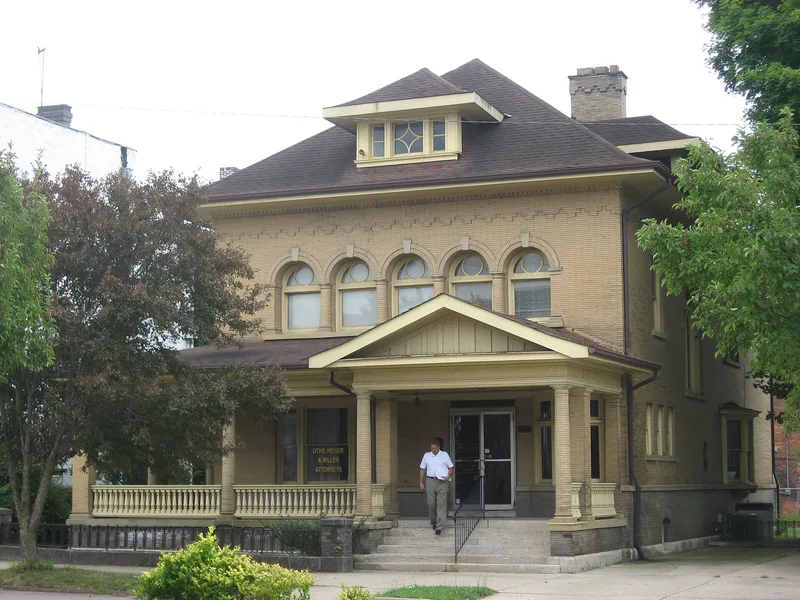
Built in 1902 at 16 E. Broadway Street in Wellston, Ohio, this two-and-a-half-story house is faced in buff brick and topped with a tile roof. A broad hip-roofed brick porch shelters the front, and a row of five arched Romanesque-style windows marks the upper story. Inside, original wall coverings, light fixtures, steam heating fixtures, tiled fireplaces, beveled glass doors, an arched stained glass window and a carved wooden swing survive. A third-floor water-gathering system shows how the house originally operated. The house was the home of Joseph Clutts (1861-1927), who arrived in Wellston in 1882 and became owner of local iron furnaces, timberland and the Wellston Sentinel newspaper, as well as a prominent Republican. Wellston's economy rested on iron and declined after about 1910, and Clutts left around 1919. Surrounded now by commercial buildings, the house is one of few remaining residences in the central business district and stands out from the town's modest workers' housing.
Significance in brief: It is associated with Joseph Clutts, a major Wellston industrialist in the iron trade, and is a fine example of early twentieth century residential architecture. It is large and elegant compared with the town's mostly modest workers' housing. Its exterior and interior features remain largely intact and well preserved.
Machine-generated summary. This summary was generated by a language model from the official nomination document and has not been reviewed line by line by an editor. It may contain errors. Check the source document before relying on any detail. Source: nomination document (PDF) · National Archives catalog entry. NRHP reference 80003105, listed November 26, 1980. Summary generated October 2026 (model claude-sonnet-5-5, prompt v1.0-2026-10-29, confidence high).
Key facts
| Address | 16 E. Broadway St., Wellston |
|---|---|
| County | Jackson County |
| Listed | November 26, 1980 |
| Reference number | 80003105 |
| Resource type | Building |
| Period of significance | 1902 |
| Areas of significance | Industry, Architecture |
| Level of significance | Local |
| Status (as stated in the nomination) | Described as in excellent condition, unaltered and on its original site; occupied and in commercial use. |
| Acreage | 0.9 |
| Coordinates | 39.12376, -82.53438 (NPS GIS) |
What listing means for this property
National Register listing is honorary for a privately owned home: it does not by itself restrict what an owner may do with their own money, and it does not require public access. Restrictions come from local landmark or historic-district ordinances, which are separate (how they differ).
Owner-occupied houses are not eligible for the 20% federal rehabilitation tax credit, which applies to income-producing buildings, but many states offer credits for homeowners. Listing also opens the door to preservation easements and to buying a plaque. Start with what listing means for homeowners, renovating a listed house and selling one.
General information, not legal or tax advice. Rules change; confirm with your State Historic Preservation Office or a qualified adviser.
Sources and further reading
- National Park Service, National Register of Historic Places database (snapshot May 2026), reference 80003105.
- Nomination form (PDF, National Archives) — catalog entry
- Wikipedia article (used for cross-checking only; text not reproduced here)
- Wikidata Q985123
- This listing as JSON
Last updated October 2026. Found an error? See the editorial policy for how to report it.