Pomerene House

Why it's listed
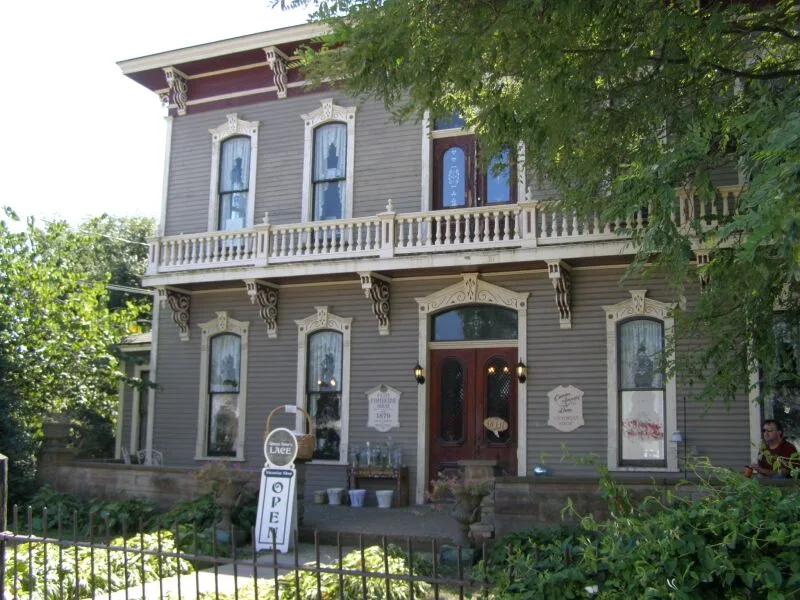
Built in 1879 in the village of Berlin, Holmes County, Ohio, this two-story wood frame house sits on a sandstone foundation and is a local example of Italianate design. Its features include a heavy bracketed cornice, tall segmental-arched windows with wood hood moldings, and a central hall with a carved open stairway. Parlors have marble fireplaces, two of them set diagonally in corners and sharing one chimney. Dr. Peter P. Pomerene, a physician practicing in Berlin since 1855, supervised construction after fire damaged his earlier residence on the site. His son Atlee Pomerene grew up in the family home, became a U.S. Senator, helped investigate the Teapot Dome scandals, and was Ohio's favorite son candidate at the 1928 Democratic convention. This is the only surviving Holmes County residence connected with him. At the time of nomination the house held apartments, while a preservation committee worked to restore its original look and open a museum.
Significance in brief: The house is mainly significant for its long association with U.S. Senator Atlee Pomerene, who grew up here and visited often during his political career. It is the only surviving residence in Holmes County tied to his life. Its architecture is of secondary importance, as Berlin's largest and most distinctive Italianate house.
Machine-generated summary. This summary was generated by a language model from the official nomination document and has not been reviewed line by line by an editor. It may contain errors. Check the source document before relying on any detail. Source: nomination document (PDF) · National Archives catalog entry. NRHP reference 80003102, listed October 20, 1980. Summary generated October 2026 (model claude-sonnet-5-5, prompt v1.0-2026-10-29, confidence high).
Key facts
| Address | U.S. 62, Berlin |
|---|---|
| County | Holmes County |
| Listed | October 20, 1980 |
| Reference number | 80003102 |
| Resource type | Building |
| Period of significance | 1879 |
| Architectural style | Italianate |
| Areas of significance | Politics/Government, Architecture |
| Level of significance | State |
| Status (as stated in the nomination) | Divided into apartments at the time of nomination; restoration was underway to return the exterior to its original appearance and create a museum in the first-floor parlors. |
| Acreage | 0.9 |
| Coordinates | 40.56135, -81.79481 (NPS GIS) |
What listing means for this property
National Register listing is honorary for a privately owned home: it does not by itself restrict what an owner may do with their own money, and it does not require public access. Restrictions come from local landmark or historic-district ordinances, which are separate (how they differ).
Owner-occupied houses are not eligible for the 20% federal rehabilitation tax credit, which applies to income-producing buildings, but many states offer credits for homeowners. Listing also opens the door to preservation easements and to buying a plaque. Start with what listing means for homeowners, renovating a listed house and selling one.
General information, not legal or tax advice. Rules change; confirm with your State Historic Preservation Office or a qualified adviser.
Sources and further reading
- National Park Service, National Register of Historic Places database (snapshot May 2026), reference 80003102.
- Nomination form (PDF, National Archives) — catalog entry
- Wikipedia article (used for cross-checking only; text not reproduced here)
- Wikidata Q29640474
- This listing as JSON
Last updated October 2026. Found an error? See the editorial policy for how to report it.