Ohio Hospital For Epileptics Stone Water Towers
Also known as: Gallipolis State Institute Stone Water Towers

Why it's listed
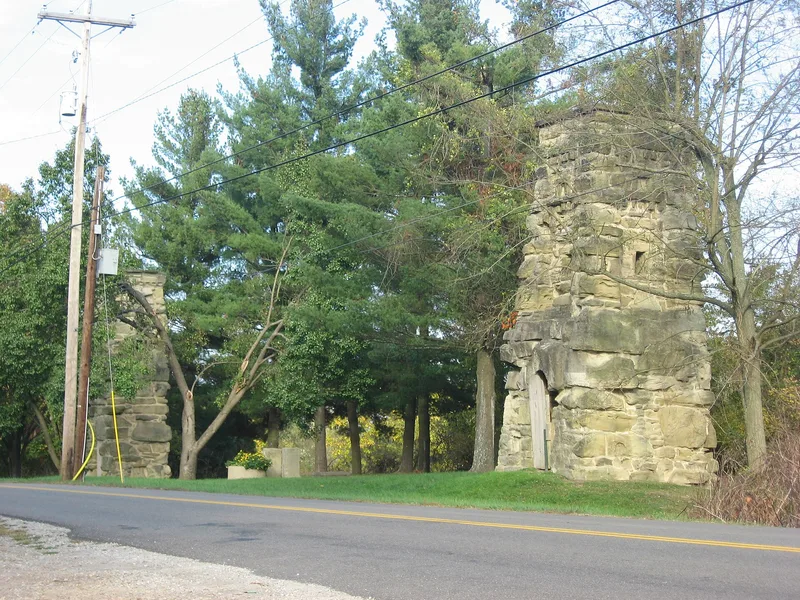
Three square stone water towers stand in a line beside Mill Creek Road in Gallipolis, Ohio. Each is two stories high and built of coursed rubble sandstone quarried from nearby hills. They served the Ohio Hospital for Epileptics, the first institution for epileptics in America said to be supported by public revenues. Built about 1895 over artesian wells, the towers received water by forced air and sent it by gravity to a cistern near the power house. Pumps were electrified about 1940, and the towers have been unused since 1950. Local builder John Andrew Stirling, possibly assisted by his father David, built or supervised them. Their decoration includes semicircular arched entrances, rock-faced dentils, stringcourses and cavetto cornices, giving a classical but primitive look. They are the only stone water towers known in Southern Ohio. In 1977 authorities ordered demolition, which was postponed so citizens could raise money for rehabilitation.
Significance in brief: The nomination cites the towers as significant examples of 19th-century engineering and architecture. They represent the work of local builder John Andrew Stirling, and are the only stone water towers known in Southern Ohio. Their classical yet primitive decoration is attributed to on-the-spot decisions during construction.
Machine-generated summary. This summary was generated by a language model from the official nomination document and has not been reviewed line by line by an editor. It may contain errors. Check the source document before relying on any detail. Source: nomination document (PDF) · National Archives catalog entry. NRHP reference 78002069, listed September 13, 1978. Summary generated October 2026 (model claude-sonnet-5-5, prompt v1.0-2026-10-29, confidence high).
Key facts
| Address | Mill Creek Rd., Gallipolis |
|---|---|
| County | Gallia County |
| Listed | September 13, 1978 |
| Reference number | 78002069 |
| Resource type | Building |
| Period of significance | ca. 1895 |
| Architect / builder | John Andrew Stirling |
| Areas of significance | Engineering, Architecture |
| Level of significance | Local |
| Status (as stated in the nomination) | Unoccupied and unused since 1950; the tanks are rusted through. Demolition ordered in 1977 was postponed while local citizens sought funds for rehabilitation and possible inclusion in the city park system. |
| Acreage | 2 |
| Coordinates | 38.82158, -82.18679 (NPS GIS) |
What listing means for this property
For a publicly owned building or structure, listing mainly matters when federal funds, permits or licences are involved: projects then go through Section 106 review so effects on the property are considered. Listing also strengthens applications for preservation grants and, for leased income-producing uses, can enable the federal rehabilitation tax credit.
Noted as vacant in the nomination. Nomination documents can be decades old; current status may differ. If you are considering buying an empty listed property, read the due-diligence checklist.
General information, not legal or tax advice. Rules change; confirm with your State Historic Preservation Office or a qualified adviser.
Sources and further reading
- National Park Service, National Register of Historic Places database (snapshot May 2026), reference 78002069.
- Nomination form (PDF, National Archives) — catalog entry
- Wikidata Q138339621
- This listing as JSON
Last updated October 2026. Found an error? See the editorial policy for how to report it.