Clemens, James and Sophia, Farmstead

Why it's listed
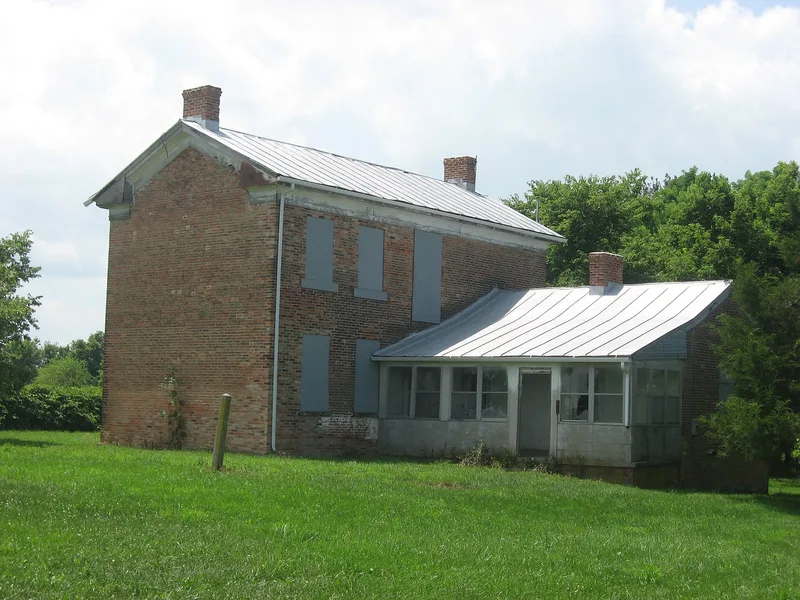
Set in the northwest corner of Darke County, near the Indiana line, this four-acre farmstead holds a two-story brick I-House and an English barn from the mid-1800s. The house has a five-bay facade, central hall, Greek Revival cornice and returns, six-over-six windows, and classical wooden fireplace surrounds inside. It faces south over open fields rather than toward the road. James Clemens, a free man of color, bought land in the area in 1818 and acquired this adjoining parcel in 1822, living here until his death in 1870. He is described as founding father of the Longtown settlement, which peaked near 900 people around 1880. Clemens helped start the first school, gave land for a Wesleyan church and established a cemetery. His family worked as farmers, ministers, teachers and businessmen, and served as Underground Railroad conductors. The property is the first Longtown site nominated, and the house has stood vacant for about twenty years.
Significance in brief: The farmstead is argued to be one of the oldest and last remaining agricultural resources in Longtown, one of Ohio's earliest black settlements. It was the home of James Clemens (1781-1870), founder of the settlement, who helped start the first school, donated land for a church and established a cemetery. The Clemens family were also conductors on the Underground Railroad and Civil War soldiers.
Machine-generated summary. This summary was generated by a language model from the official nomination document and has not been reviewed line by line by an editor. It may contain errors. Check the source document before relying on any detail. Source: nomination document (PDF) · National Archives catalog entry. NRHP reference 01000199, listed March 15, 2001. Summary generated October 2026 (model claude-sonnet-5-5, prompt v1.0-2026-10-29, confidence high).
Key facts
| Address | 467 Stingley Rd., Palestine |
|---|---|
| County | Darke County |
| Listed | March 15, 2001 |
| Reference number | 01000199 |
| Resource type | Building |
| Period of significance | 1822-1880 |
| Architectural style | Mid 19th Century/Greek Revival; Other: Classic I-House |
| Criteria |
|
| Areas of significance | Black |
| Level of significance | Local |
| Status (as stated in the nomination) | The house has been vacant for about 20 years but retains its interior integrity, including two original wood fireplace surrounds. |
| Acreage | 4 |
| Coordinates | 40.07756, -84.79517 (NPS GIS) |
What listing means for this property
National Register listing is honorary for a privately owned home: it does not by itself restrict what an owner may do with their own money, and it does not require public access. Restrictions come from local landmark or historic-district ordinances, which are separate (how they differ).
Owner-occupied houses are not eligible for the 20% federal rehabilitation tax credit, which applies to income-producing buildings, but many states offer credits for homeowners. Listing also opens the door to preservation easements and to buying a plaque. Start with what listing means for homeowners, renovating a listed house and selling one.
Noted as vacant in the nomination. Nomination documents can be decades old; current status may differ. If you are considering buying an empty listed property, read the due-diligence checklist.
General information, not legal or tax advice. Rules change; confirm with your State Historic Preservation Office or a qualified adviser.
Sources and further reading
- National Park Service, National Register of Historic Places database (snapshot May 2026), reference 01000199.
- Nomination form (PDF, National Archives) — catalog entry
- Wikipedia article (used for cross-checking only; text not reproduced here)
- Wikidata Q6146017
- This listing as JSON
Last updated October 2026. Found an error? See the editorial policy for how to report it.