Townes, Clayton, House

Why it's listed
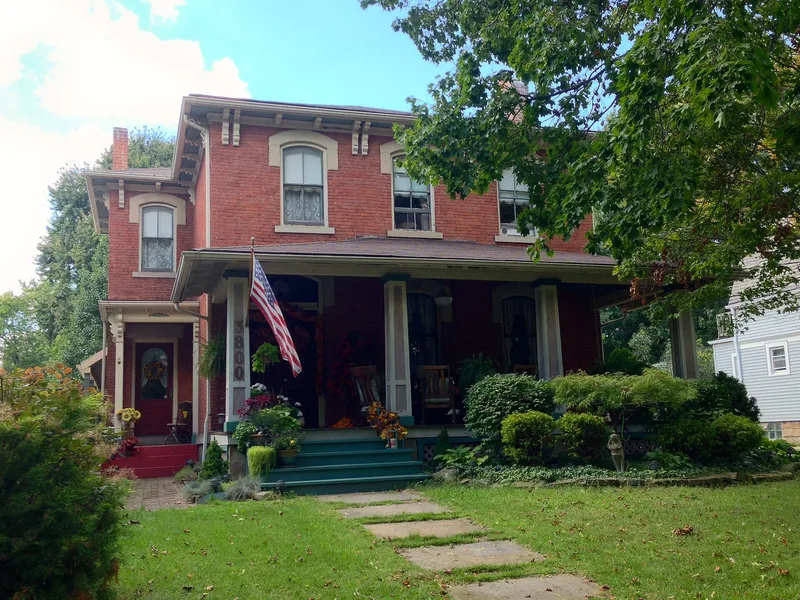
This two-story brick house at 3800 West 33rd Street in Cleveland's Brooklyn Centre neighborhood dates to about 1865 and is an early example of the Italianate style. It has segmental arched windows topped by brick hood moldings, paired brackets with widely spaced consoles, and a corbelled brick cornice. Inside are a broad open stairway and high-ceilinged rooms. Only two brick Italianate houses survive in the neighborhood, the other being the Adam Poe House, and brick examples stand out against the many frame houses nearby. The house was among the most imposing residences in the area when built. It is also tied to Clayton Townes, a long-serving city councilman who lived here into at least the 1920s. As council president during Cleveland's brief city manager era, he held the title of mayor and worked with city manager William Hopkins on the creation of Cleveland Hopkins Airport. The original owner is unknown. The porch columns were altered around 1900.
Significance in brief: The nomination argues the house is a rare, unusually early example of brick Italianate residential architecture in the area, distinguished by its corbelled brick cornice and brick hood moldings. It also has a local historical link to Clayton Townes, who as president of city council served as Cleveland's mayor during the 1920s city manager period and helped establish Cleveland Hopkins Airport.
Machine-generated summary. This summary was generated by a language model from the official nomination document and has not been reviewed line by line by an editor. It may contain errors. Check the source document before relying on any detail. Source: nomination document (PDF) · National Archives catalog entry. NRHP reference 87000435, listed March 19, 1987. Summary generated October 2026 (model claude-sonnet-5-5, prompt v1.0-2026-10-29, confidence medium).
Key facts
| Address | 3800 W. Thirty-third St., Cleveland |
|---|---|
| County | Cuyahoga County |
| Listed | March 19, 1987 |
| Reference number | 87000435 |
| Resource type | Building |
| Architectural style | Italianate |
| Areas of significance | Politics/Government, Architecture |
| Level of significance | Local |
| Status (as stated in the nomination) | Used as a residence; interior in good condition and exterior in fair condition, with the porch columns altered around the turn of the century. |
| Acreage | 0.9 |
| Within district | Brooklyn Centre Historic District |
| Coordinates | 41.45167, -81.70501 (NPS GIS) |
What listing means for this property
National Register listing is honorary for a privately owned home: it does not by itself restrict what an owner may do with their own money, and it does not require public access. Restrictions come from local landmark or historic-district ordinances, which are separate (how they differ).
Owner-occupied houses are not eligible for the 20% federal rehabilitation tax credit, which applies to income-producing buildings, but many states offer credits for homeowners. Listing also opens the door to preservation easements and to buying a plaque. Start with what listing means for homeowners, renovating a listed house and selling one.
General information, not legal or tax advice. Rules change; confirm with your State Historic Preservation Office or a qualified adviser.
Sources and further reading
- National Park Service, National Register of Historic Places database (snapshot May 2026), reference 87000435.
- Nomination form (PDF, National Archives) — catalog entry
- Wikidata Q137708086
- This listing as JSON
Last updated October 2026. Found an error? See the editorial policy for how to report it.