Hanoverton Canal Town District

The pin is a point inside the NPS boundary polygon, not a surveyed location.
Why it's listed
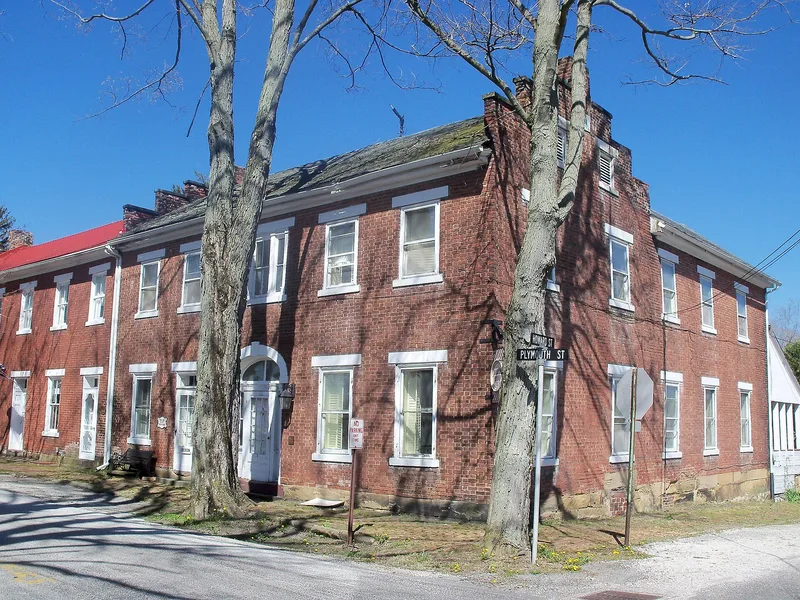
Hanoverton's canal town district covers 23 acres in Columbiana County, Ohio. James Craig platted the community in 1813 as Hanover, and brick houses along Plymouth Street were well underway by 1817. Speculators expected a city to rival those in the East, so buildings were packed onto small lots, but the boom never came. The Beaver and Sandy Canal, begun in 1834 and completed in 1848, never operated commercially, and the company went bankrupt. The district's notable buildings include the 1817 Michael Arter House, the 1831 Sloan Brick Row, which began as an inn and tavern, and the richly ornamented Spread Eagle Tavern of 1837, with its ballroom and early Masonic temple. Two-story brick and frame houses, a Christian Church of 1859 and a Queen Anne Presbyterian Church of 1900 complete the street. Plymouth Street has stayed largely unchanged since the early 1840s, preserving the look of a small canal-era town.
Significance in brief: The nomination argues the district holds some of the best examples of canal-era architecture in Ohio and remains largely unchanged since the canal's heyday. Speculators expected a large city, but the Beaver and Sandy Canal, finished in 1848, never operated commercially and the town stalled. As a result, Plymouth Street's early buildings survive with no intrusions.
Machine-generated summary. This summary was generated by a language model from the official nomination document and has not been reviewed line by line by an editor. It may contain errors. Check the source document before relying on any detail. Source: nomination document (PDF) · National Archives catalog entry. NRHP reference 77001050, listed August 3, 1977. Summary generated October 2026 (model claude-sonnet-5-5, prompt v1.0-2026-10-29, confidence medium).
Key facts
| Address | U.S. 30, Hanoverton |
|---|---|
| County | Columbiana County |
| Listed | August 3, 1977 |
| Reference number | 77001050 |
| Resource type | District |
| Period of significance | 1817-1850 |
| Architectural style | Queen Anne (Presbyterian Church); otherwise simple canal-era brick and frame buildings |
| Areas of significance | Architecture |
| Level of significance | State |
| Status (as stated in the nomination) | Occupied; Plymouth Street is described as unchanged since the early 1840s with no intrusions. The canal itself has left no remains, only a narrow ditch periodically filled with water. An old brick school is now a warehouse. |
| Acreage | 23 |
| Coordinates | 40.75298, -80.93579 (NPS GIS) |
What listing means for this property
This is a historic district. Buildings within its boundary are either contributing (they add to the district's significance) or non-contributing. Owners of contributing income-producing buildings can claim the 20% federal rehabilitation tax credit; homeowners should look at state credits. National Register districts impose no design review by themselves; a local historic district ordinance, if one exists, does (the difference explained).
General information, not legal or tax advice. Rules change; confirm with your State Historic Preservation Office or a qualified adviser.
Sources and further reading
- National Park Service, National Register of Historic Places database (snapshot May 2026), reference 77001050.
- Nomination form (PDF, National Archives) — catalog entry
- Wikipedia article (used for cross-checking only; text not reproduced here)
- Wikidata Q5649477
- This listing as JSON
Last updated October 2026. Found an error? See the editorial policy for how to report it.