East Liverpool Pottery
Also known as: Goodwin-Baggott-Eagle-Mountford Pottery

Why it's listed
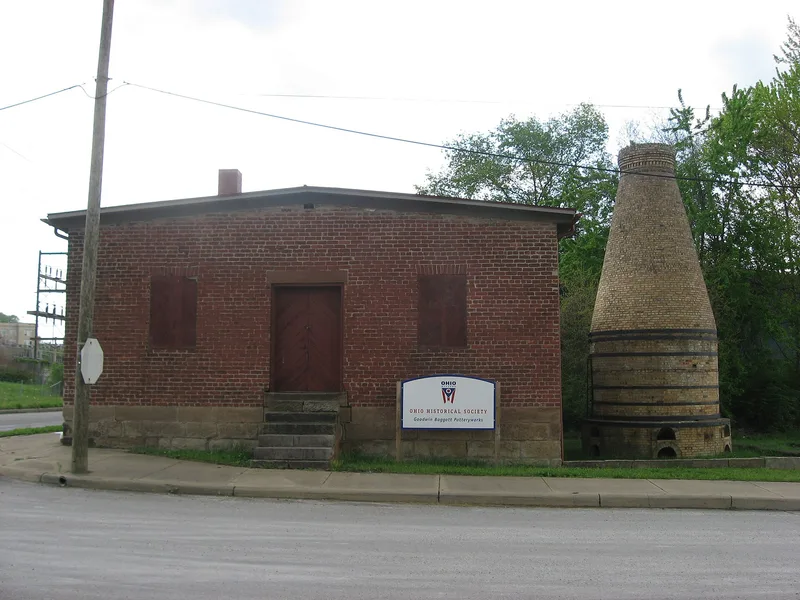
At the southeast corner of Second and Market Streets in East Liverpool, Ohio, the remains of an old pottery works preserve one of the oldest bottle kilns in the United States. The plant began in 1844 as John Goodwin's small yellow ware pottery. Samuel and William Baggott bought it in 1853 and later operated it as the Eagle Pottery, making Rockingham and yellow ware for decades. Mountford & Son used the site from 1902 for potters' supplies such as stilts and pins, and production ceased in 1939. The buildings then decayed, and the rear section was demolished in 1970. The front walls and the kiln survived. The kiln is the oldest of three remaining in the East Liverpool area. The State of Ohio acquired the pottery, and the Ohio Historical Society planned archaeological study, wall stabilization and restoration as a working museum of the early Ohio pottery industry.
Significance in brief: The upright bottle kiln is by far the oldest of the three remaining in the East Liverpool area, once a center for yellow ware and Rockingham production. It is also one of the oldest kilns of its type surviving in the United States. The site traces the early Ohio pottery industry from John Goodwin's pottery through the Baggott and Mountford operations.
Machine-generated summary. This summary was generated by a language model from the official nomination document and has not been reviewed line by line by an editor. It may contain errors. Check the source document before relying on any detail. Source: nomination document (PDF) · National Archives catalog entry. NRHP reference 71000636, listed October 7, 1971. Summary generated October 2026 (model claude-sonnet-5-5, prompt v1.0-2026-10-29, confidence medium).
Key facts
| Address | SE corner of 2nd and Market Sts., East Liverpool |
|---|---|
| County | Columbiana County |
| Listed | October 7, 1971 |
| Reference number | 71000636 |
| Resource type | Building |
| Period of significance | 19th Century (specific date 1844) |
| Areas of significance | Industry |
| Level of significance | Local |
| Status (as stated in the nomination) | Partly razed in 1969-70; front walls and the bottle kiln were saved. The form lists the property as presently vacant, in fair condition and altered, owned by the State of Ohio, with plans for stabilization and restoration as a working museum. |
| Acreage | 0.9 |
| Coordinates | 40.61657, -80.58083 (NPS GIS) |
What listing means for this property
National Register listing is honorary: it recognises significance and does not restrict what a private owner may do without federal money or permits. It unlocks the 20% federal rehabilitation tax credit for income-producing buildings, state credits in many states, and Section 106 review when federal agencies are involved. See what listing means in practice.
Noted as vacant in the nomination. Nomination documents can be decades old; current status may differ. If you are considering buying an empty listed property, read the due-diligence checklist.
General information, not legal or tax advice. Rules change; confirm with your State Historic Preservation Office or a qualified adviser.
Sources and further reading
- National Park Service, National Register of Historic Places database (snapshot May 2026), reference 71000636.
- Nomination form (PDF, National Archives) — catalog entry
- Wikipedia article (used for cross-checking only; text not reproduced here)
- Wikidata Q5328853
- This listing as JSON
Last updated October 2026. Found an error? See the editorial policy for how to report it.