Winter, William, Stone House
Also known as: Arch and Joan Carr Residence

Why it's listed
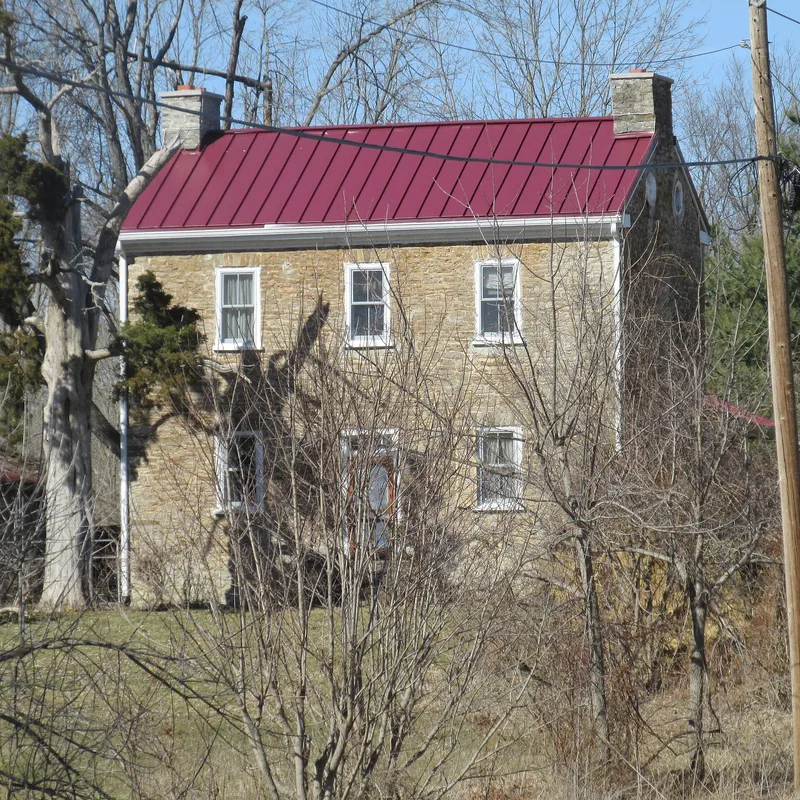
Built around 1803, this 2-1/2 story coursed stone house north of Mt. Olive in Clermont County, Ohio, was home to William Winter, a Virginian who arrived in Tate Township in 1801 and began the settlement that became Mt. Olive. The three-bay house has stone voussoirs over its openings, a carved frieze molding, two round windows high in each gable end, and much of its original black walnut woodwork. A small stone cabin that sheltered the family during construction survives at the rear, joined to a ca. 1850 frame addition and a brick summer kitchen. The house served as a general store, and the kitchen held the post office from 1848 to 1880. Winter's son William H. explored Missouri, Oregon and California in the 1840s, and his journal, published in 1848, was used as a guide by westbound travelers. The family sold the property in 1934, after which it declined and was used for tobacco drying before restoration began in 1973.
Significance in brief: The nomination calls it an excellent example of an early Ohio stone building, with decorative frieze molding and round gable windows of special interest. It was the home of one of the earliest settlers in Tate Township. It was also the childhood home of William H. Winter, a western explorer of the 1840s whose published journal guided travelers west.
Machine-generated summary. This summary was generated by a language model from the official nomination document and has not been reviewed line by line by an editor. It may contain errors. Check the source document before relying on any detail. Source: nomination document (PDF) · National Archives catalog entry. NRHP reference 77001049, listed March 25, 1977. Summary generated October 2026 (model claude-sonnet-5-5, prompt v1.0-2026-10-29, confidence medium).
Key facts
| Address | N of Mt. Olive on OH 133, Mt. Olive |
|---|---|
| County | Clermont County |
| Listed | March 25, 1977 |
| Reference number | 77001049 |
| Resource type | Building |
| Period of significance | 1803-1934 |
| Areas of significance | Exploration/Settlement, Architecture |
| Level of significance | Local |
| Status (as stated in the nomination) | Occupied as a private residence; the current owners bought it in 1973 and are restoring it as their home. |
| Acreage | 0.9 |
| Coordinates | 38.89078, -84.09246 (NPS GIS) |
What listing means for this property
National Register listing is honorary for a privately owned home: it does not by itself restrict what an owner may do with their own money, and it does not require public access. Restrictions come from local landmark or historic-district ordinances, which are separate (how they differ).
Owner-occupied houses are not eligible for the 20% federal rehabilitation tax credit, which applies to income-producing buildings, but many states offer credits for homeowners. Listing also opens the door to preservation easements and to buying a plaque. Start with what listing means for homeowners, renovating a listed house and selling one.
General information, not legal or tax advice. Rules change; confirm with your State Historic Preservation Office or a qualified adviser.
Sources and further reading
- National Park Service, National Register of Historic Places database (snapshot May 2026), reference 77001049.
- Nomination form (PDF, National Archives) — catalog entry
- Wikipedia article (used for cross-checking only; text not reproduced here)
- Wikidata Q8020479
- This listing as JSON
Last updated October 2026. Found an error? See the editorial policy for how to report it.