Kenton-Hunt Farm
Also known as: Kenton Farm

Why it's listed
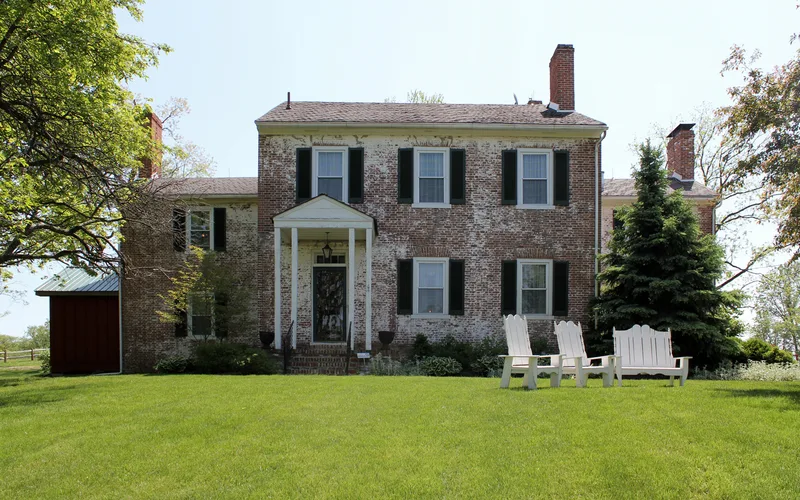
Located north of Springfield in Clark County, Ohio, this farm centers on a two-story late Federal brick house with flanking wings, built between 1828 and 1832 for the Ralph Hunt family. Its bridged chimneys, flat jack-arched window openings, and woodwork reflect early nineteenth-century design, with a southern influence in the tall central block and lower wings. A brick springhouse stands over an artesian spring, and its paneled door is a fine example of the period's woodwork. Simon Kenton, the celebrated frontiersman, built a log house nearby in 1799, drawn by that spring, and later lost the farm to debt after overextending himself in land speculation. The farm is also known as the home of Major William Hunt, an early promoter of the Mad River and Lake Erie Railroad. A small frame way-station from that line was moved here in 1937 and is now used for storage.
Significance in brief: The farm is tied to Simon Kenton, a renowned Ohio frontiersman who built a log house here in 1799 beside an artesian spring. It is also notable as a highly unusual Federal-period vernacular example for West Central Ohio. Major William Hunt, who lived here, helped promote the Mad River and Lake Erie Railroad, which crossed the farm.
Machine-generated summary. This summary was generated by a language model from the official nomination document and has not been reviewed line by line by an editor. It may contain errors. Check the source document before relying on any detail. Source: nomination document (PDF) · National Archives catalog entry. NRHP reference 80002955, listed February 8, 1980. Summary generated October 2026 (model claude-sonnet-5-5, prompt v1.0-2026-10-29, confidence medium).
Key facts
| Address | N of Springfield at 4690 Urbana Rd., Springfield |
|---|---|
| County | Clark County |
| Listed | February 8, 1980 |
| Reference number | 80002955 |
| Resource type | Building |
| Period of significance | 1700-1799, 1800-1899 |
| Architectural style | Late Federal vernacular |
| Areas of significance | Exploration/Settlement, Architecture |
| Level of significance | State |
| Status (as stated in the nomination) | Listed as in good condition and occupied; used for agriculture and as a private residence. The house has had modern alterations and masonry repairs, and the relocated way-station is used for storage. |
| Acreage | 6 |
| Coordinates | 39.99250, -83.80291 (NPS GIS) |
What listing means for this property
National Register listing is honorary for a privately owned home: it does not by itself restrict what an owner may do with their own money, and it does not require public access. Restrictions come from local landmark or historic-district ordinances, which are separate (how they differ).
Owner-occupied houses are not eligible for the 20% federal rehabilitation tax credit, which applies to income-producing buildings, but many states offer credits for homeowners. Listing also opens the door to preservation easements and to buying a plaque. Start with what listing means for homeowners, renovating a listed house and selling one.
General information, not legal or tax advice. Rules change; confirm with your State Historic Preservation Office or a qualified adviser.
Sources and further reading
- National Park Service, National Register of Historic Places database (snapshot May 2026), reference 80002955.
- Nomination form (PDF, National Archives) — catalog entry
- Wikidata Q137607385
- This listing as JSON
Last updated October 2026. Found an error? See the editorial policy for how to report it.