St. Paul AME Church

Why it's listed
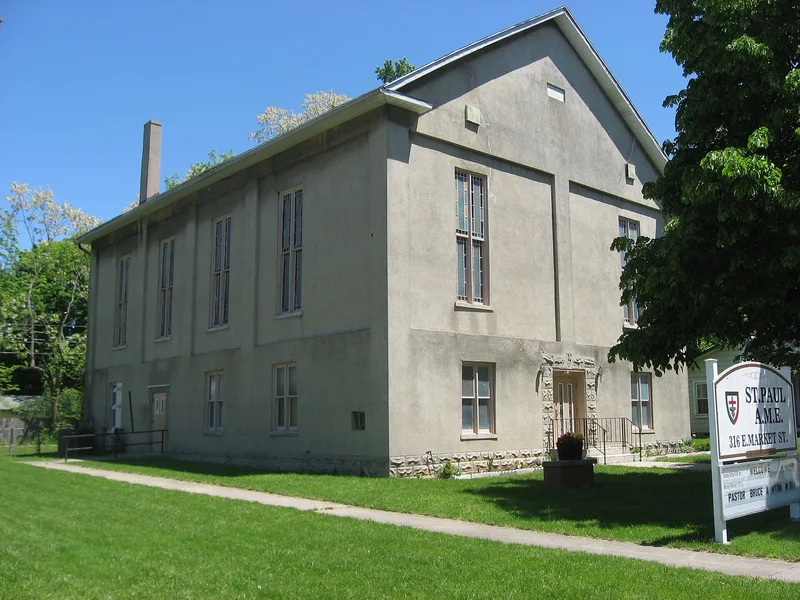
St. Paul A.M.E. Church is a two-and-a-half-story brick building at 316 East Market Street in Urbana, Ohio. It is a vernacular version of Greek Revival design, with a front-facing gable, cornice returns and symmetrical windows. Stucco was applied to the brick in 1922. A marble block on the front reads 1866, though the building was not completed until 1876. Inside, two curved walnut staircases lead to a second-floor sanctuary with stained glass windows, original pews and a mural of Christ ascending, painted in the late 1940s or early 1950s by local artist Alice Archer Sewall-James. The congregation was organized in 1824 on the same site, among the first A.M.E. groups in western Ohio. Its first pastor in the new building was Benjamin W. Arnett, a nationally known church leader. The church is listed for its place in Urbana's African-American community, its Arnett connection, and its raised-basement, upper-floor sanctuary plan, which has southern antecedents.
Significance in brief: The nomination argues significance under Criterion A for its long role as the spiritual, social and cultural center of Champaign County's African-American community. Under Criterion B it is tied to Benjamin W. Arnett, its first pastor, and under Criterion C it represents a church plan with southern antecedents (raised basement, vestibule, second-floor auditorium). It is described as the largest and best preserved of the county's six historic 19th-century African-American churches.
Machine-generated summary. This summary was generated by a language model from the official nomination document and has not been reviewed line by line by an editor. It may contain errors. Check the source document before relying on any detail. Source: nomination document (PDF) · National Archives catalog entry. NRHP reference 97000954, listed September 5, 1997. Summary generated October 2026 (model claude-sonnet-5-5, prompt v1.0-2026-10-29, confidence high).
Key facts
| Address | 316 E. Market St., Urbana |
|---|---|
| County | Champaign County |
| Listed | September 5, 1997 |
| Reference number | 97000954 |
| Resource type | Building |
| Period of significance | 1876-1947 |
| Architectural style | Mid-19th Century/Greek Revival, Vernacular |
| Criteria |
|
| Areas of significance | Social History, Religion, Black, Ethnic Heritage, Architecture |
| Level of significance | Local |
| Status (as stated in the nomination) | Still used as a church and meeting hall; the form lists current functions as church and social meeting hall. |
| Acreage | 0.9 |
| Coordinates | 40.12817, -82.56519 (NPS GIS) |
What listing means for this property
Religious properties are listed for their architectural or historical significance, not their religious use. Listing is honorary and does not restrict the congregation's use of the building. The federal rehabilitation credit is generally unavailable unless part of the building is income-producing; some state programmes and preservation grants do cover religious buildings. Federal funding or permits trigger Section 106 review.
General information, not legal or tax advice. Rules change; confirm with your State Historic Preservation Office or a qualified adviser.
Sources and further reading
- National Park Service, National Register of Historic Places database (snapshot May 2026), reference 97000954.
- Nomination form (PDF, National Archives) — catalog entry
- Wikipedia article (used for cross-checking only; text not reproduced here)
- Wikidata Q7591017
- This listing as JSON
Last updated October 2026. Found an error? See the editorial policy for how to report it.