Cochran Farm
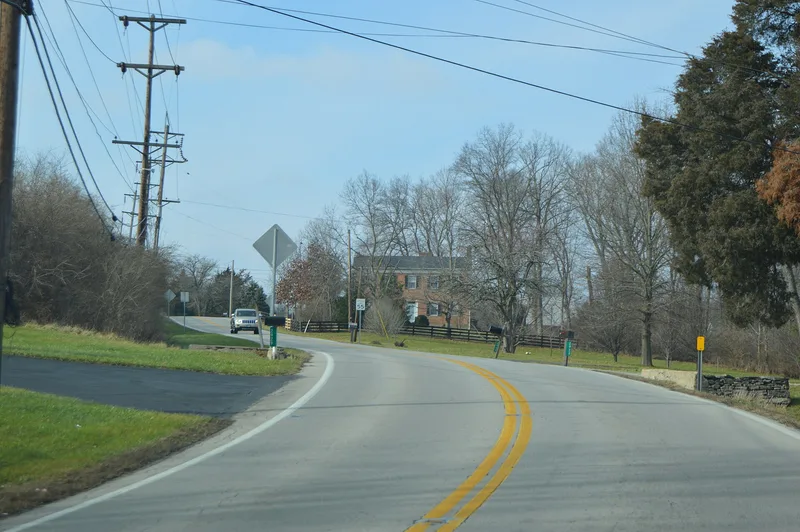

Why it's listed
Near Millville in Butler County, Ohio, this farm group is built around a T-shaped, two-story brick farmhouse completed about 1836 by James W. Cochran. The house is five bays wide with a central doorway and six-over-six windows. Its limestone foundation came from Indian Creek on the property, the bricks were handmade, and the lumber was cut on site. Inside, most woodwork is walnut, and a circular staircase rises from the center hall. A two-story limestone dairy and smokehouse stands to the north, with a bell cupola. A wood bank barn and a corn crib and storage barn complete the group. The Cochran family arrived from Pennsylvania in 1814 and later bought the Millville Mill, which James W. Cochran took over. The property was recognized because the house, dairy and barns remain essentially unaltered and illustrate a mid-19th century farm group in southern Ohio. A proposed power transmission line east of the house was noted as a concern.
Significance in brief: The nomination presents the essentially unaltered house, dairy and barns as a fine example of a mid-19th century farm group in southern Ohio. It also records the Cochran family's role in the area, including ownership of the Millville Mill.
Machine-generated summary. This summary was generated by a language model from the official nomination document and has not been reviewed line by line by an editor. It may contain errors. Check the source document before relying on any detail. Source: nomination document (PDF) · National Archives catalog entry. NRHP reference 73001390, listed July 16, 1973. Summary generated October 2026 (model claude-sonnet-5-5, prompt v1.0-2026-10-29, confidence medium).
Key facts
| Address | 2900 OH 129, Millville |
|---|---|
| County | Butler County |
| Listed | July 16, 1973 |
| Reference number | 73001390 |
| Resource type | Building |
| Period of significance | 19th Century (specific date ca. 1836) |
| Architect / builder | James W. Cochran (builder of the farmhouse) |
| Areas of significance | Architecture |
| Level of significance | Local |
| Status (as stated in the nomination) | Condition is given as good and altered, and the property is private and occupied as a residence. The nomination notes a proposed electric transmission line east of the house as a threat. |
| Acreage | 8 |
| Coordinates | 39.38824, -84.65959 (NPS GIS) |
What listing means for this property
National Register listing is honorary for a privately owned home: it does not by itself restrict what an owner may do with their own money, and it does not require public access. Restrictions come from local landmark or historic-district ordinances, which are separate (how they differ).
Owner-occupied houses are not eligible for the 20% federal rehabilitation tax credit, which applies to income-producing buildings, but many states offer credits for homeowners. Listing also opens the door to preservation easements and to buying a plaque. Start with what listing means for homeowners, renovating a listed house and selling one.
General information, not legal or tax advice. Rules change; confirm with your State Historic Preservation Office or a qualified adviser.
Sources and further reading
- National Park Service, National Register of Historic Places database (snapshot May 2026), reference 73001390.
- Nomination form (PDF, National Archives) — catalog entry
- Wikipedia article (used for cross-checking only; text not reproduced here)
- Wikidata Q5139420
- This listing as JSON
Last updated October 2026. Found an error? See the editorial policy for how to report it.