Red Oak Presbyterian Church

Why it's listed
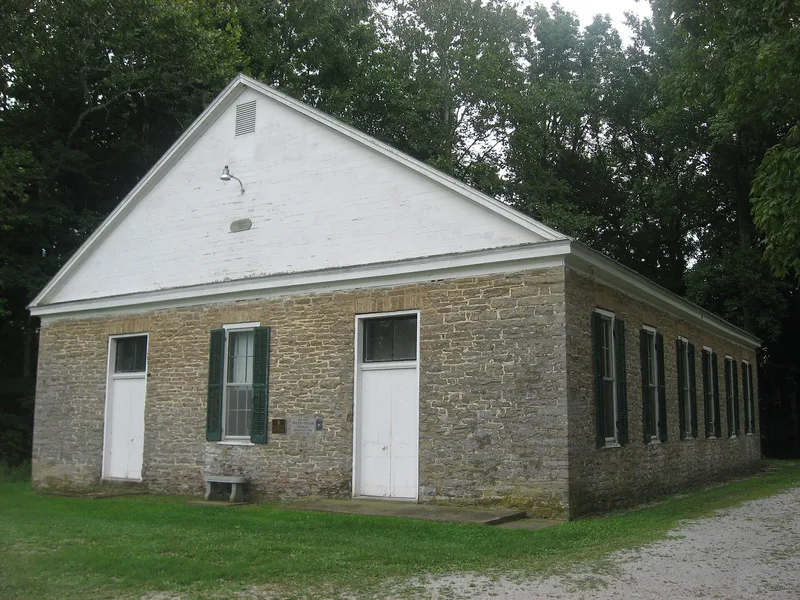
Red Oak Presbyterian Church is a one-story limestone meeting house set in a grove of trees off U.S. Route 68 on Cemetery Road, near Ripley in Brown County, Ohio. Built in 1817 with coursed, squared limestone walls 24 inches thick, it has a gently pitched pedimented gable roof, two front doors flanking a central window, and six matching windows along each side. A cement block addition was made at the rear in 1948 but is hidden from the access road. The congregation, organized in 1798, was the first in Brown County. Its minister from 1805 to 1841, the Rev. James Gilliland, helped hundreds of fleeing slaves travel through Ohio and held rallies and sermons for the abolitionist cause, and he is buried in the adjoining cemetery. Few early stone buildings survive in the county, most of them homes, and this is believed to be its only stone church of the period. The old cemetery, with its dry-laid rock wall and graves of Revolutionary and Civil War veterans, is part of the setting.
Significance in brief: The nomination argues the church is significant as an example of early stone architecture, being the only stone church from its era known to remain in Brown County. It is also tied to the Rev. James Gilliland, an important southern Ohio abolitionist who served as its minister from 1805 to 1841. The adjacent old cemetery contributes to the setting.
Machine-generated summary. This summary was generated by a language model from the official nomination document and has not been reviewed line by line by an editor. It may contain errors. Check the source document before relying on any detail. Source: nomination document (PDF) · National Archives catalog entry. NRHP reference 82003547, listed June 17, 1982. Summary generated October 2026 (model claude-sonnet-5-5, prompt v1.0-2026-10-29, confidence high).
Key facts
| Address | Cemetery Rd., Ripley |
|---|---|
| County | Brown County |
| Listed | June 17, 1982 |
| Reference number | 82003547 |
| Resource type | Building |
| Period of significance | 1800-1899 |
| Architectural style | Simple vernacular stone building |
| Areas of significance | Architecture, Social History |
| Level of significance | State |
| Status (as stated in the nomination) | Occupied and in regular use as a church since construction; condition listed as good and unaltered, with a 1948 rear addition and interior updates. |
| Acreage | 1 |
| Coordinates | 38.79549, -83.79554 (NPS GIS) |
What listing means for this property
Religious properties are listed for their architectural or historical significance, not their religious use. Listing is honorary and does not restrict the congregation's use of the building. The federal rehabilitation credit is generally unavailable unless part of the building is income-producing; some state programmes and preservation grants do cover religious buildings. Federal funding or permits trigger Section 106 review.
General information, not legal or tax advice. Rules change; confirm with your State Historic Preservation Office or a qualified adviser.
Sources and further reading
- National Park Service, National Register of Historic Places database (snapshot May 2026), reference 82003547.
- Nomination form (PDF, National Archives) — catalog entry
- Wikipedia article (used for cross-checking only; text not reproduced here)
- Wikidata Q7304682
- This listing as JSON
Last updated October 2026. Found an error? See the editorial policy for how to report it.