Morristown Historic District
Also known as: See also:Ephraim Gaston House
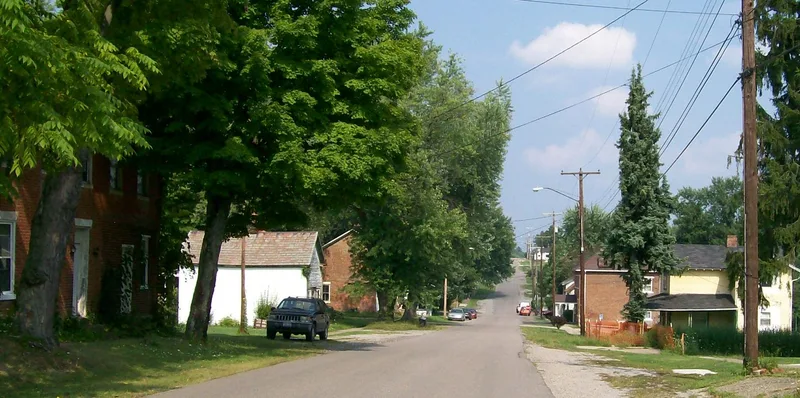

Why it's listed
Morristown is a village in Belmont County, Ohio, that grew up along the National Road, which came through around 1826. By the 1850s it supported forty to fifty businesses serving road traffic, including blacksmiths, saddlers, wagon makers, hotels, a woolen mill and cigar and glove factories. The railroad and later U.S. 40 bypassed the town, and commerce faded. Today it is a residential community of 86 buildings and a cemetery, most of the important ones built between 1840 and 1870. Many are two-story brick houses laid in Flemish bond, an unusual pattern for the region. Four similar brick churches sit above Main Street. Buildings stand close to the street on lots that keep their original 148-foot depth, giving the town a continuous scale. Notable buildings include the 1874 Italianate Eaton House and the 1851 Greek Revival Ephraim Gaston House. The district was recognized as the most intact National Road town in Eastern Ohio.
Significance in brief: The nomination calls it the most intact National Road town in Eastern Ohio. Its buildings reflect the trade the road generated in the second through fourth quarters of the nineteenth century. The streetscape, the many Flemish bond brick houses, and the original 148-foot lot depths give the town a cohesive scale.
Machine-generated summary. This summary was generated by a language model from the official nomination document and has not been reviewed line by line by an editor. It may contain errors. Check the source document before relying on any detail. Source: nomination document (PDF) · National Archives catalog entry. NRHP reference 80002943, listed March 6, 1980. Summary generated October 2026 (model claude-sonnet-5-5, prompt v1.0-2026-10-29, confidence medium).
Key facts
| Address | Church, Main, W. Cross, E. Cross, and Middle Cross Sts., Morristown |
|---|---|
| County | Belmont County |
| Listed | March 6, 1980 |
| Reference number | 80002943 |
| Resource type | District |
| Period of significance | 1800-1899 |
| Architectural style | Vernacular and folk architecture, with Greek Revival, Gothic Revival and Italianate examples |
| Areas of significance | Commerce, Transportation, Architecture |
| Level of significance | Local |
| Status (as stated in the nomination) | Mostly residential. No businesses remain, and former commercial buildings are used as dwellings or storage. Condition ranges from poor to excellent, with considerable rehabilitation under way. |
| Acreage | 42 |
| Coordinates | 40.06368, -81.07229 (NPS GIS) |
What listing means for this property
This is a historic district. Buildings within its boundary are either contributing (they add to the district's significance) or non-contributing. Owners of contributing income-producing buildings can claim the 20% federal rehabilitation tax credit; homeowners should look at state credits. National Register districts impose no design review by themselves; a local historic district ordinance, if one exists, does (the difference explained).
General information, not legal or tax advice. Rules change; confirm with your State Historic Preservation Office or a qualified adviser.
Sources and further reading
- National Park Service, National Register of Historic Places database (snapshot May 2026), reference 80002943.
- Nomination form (PDF, National Archives) — catalog entry
- Wikipedia article (used for cross-checking only; text not reproduced here)
- Wikidata Q6914124
- This listing as JSON
Last updated October 2026. Found an error? See the editorial policy for how to report it.