Fledderjohann, H. E., House, Doctor's Office and Summer Kitchen

Why it's listed
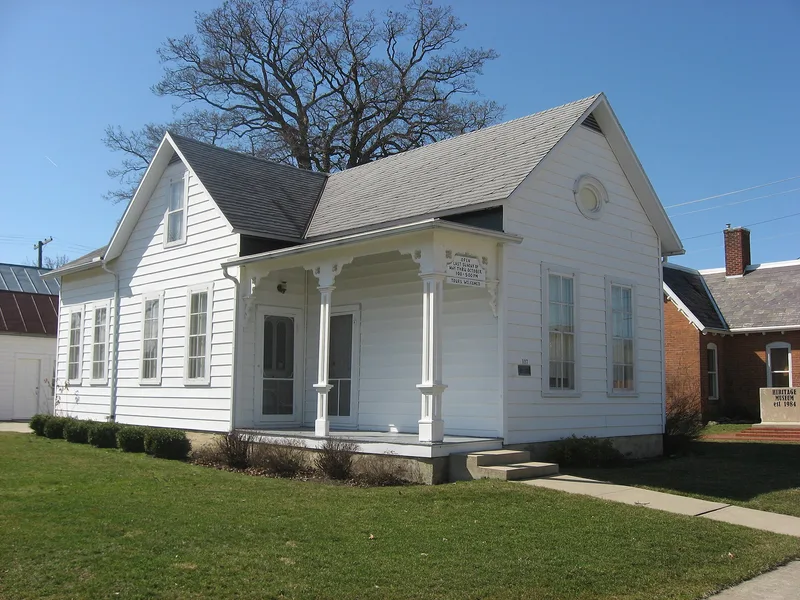
Three surviving buildings at 107 E. German Street in New Knoxville, Ohio, mark the home and workplace of Dr. Henry E. Fledderjohann. The one-and-a-half story frame house dates to about 1879 and has a gabled ell form, a veranda with sawn columns and fretwork, and aluminum siding added in 1950. Beside it stands the brick doctor's office, built in 1888, with a pointed arch window and door, a trussed projecting eave, a jerkin-head slate roof and an unaltered interior of original woodwork, drawers and shelves. A frame summer kitchen completes the group. Fledderjohann was born in 1855, graduated from the University of Pennsylvania in 1886, and opened his New Knoxville practice in 1888. He kept making house calls by horse and buggy, spoke German and English, sold his own medicines and practiced homeopathy. He lived on the property until his death in 1950. The buildings were listed for their link to his long career as a small-town family doctor.
Significance in brief: The buildings are nominated under Criterion B for their association with Dr. Henry E. Fledderjohann, a leading New Knoxville physician who practiced from 1886 to 1940. His 52-year practice, which relied on house calls and his own medicines, is presented as representative of small-town family medicine. His career also spanned a period when medical practice changed and many deadly diseases were brought under control.
Machine-generated summary. This summary was generated by a language model from the official nomination document and has not been reviewed line by line by an editor. It may contain errors. Check the source document before relying on any detail. Source: nomination document (PDF) · National Archives catalog entry. NRHP reference 93001388, listed December 10, 1993. Summary generated October 2026 (model claude-sonnet-5-5, prompt v1.0-2026-10-29, confidence high).
Key facts
| Address | 107 E. German St., New Knoxville |
|---|---|
| County | Auglaize County |
| Listed | December 10, 1993 |
| Reference number | 93001388 |
| Resource type | Building |
| Period of significance | 1886 - 1940 |
| Architect / builder | Unknown |
| Architectural style | Italianate; Queen Anne |
| Criteria |
|
| Areas of significance | Health/Medicine |
| Level of significance | Local |
| Status (as stated in the nomination) | Current function is listed as vacant. The doctor's office interior is unaltered but needs major restoration for cracked plaster and damaged floor boards. The barn was demolished. |
| Acreage | 2 |
| Coordinates | 40.49351, -84.31544 (NPS GIS) |
What listing means for this property
National Register listing is honorary for a privately owned home: it does not by itself restrict what an owner may do with their own money, and it does not require public access. Restrictions come from local landmark or historic-district ordinances, which are separate (how they differ).
Owner-occupied houses are not eligible for the 20% federal rehabilitation tax credit, which applies to income-producing buildings, but many states offer credits for homeowners. Listing also opens the door to preservation easements and to buying a plaque. Start with what listing means for homeowners, renovating a listed house and selling one.
Noted as vacant in the nomination. Nomination documents can be decades old; current status may differ. If you are considering buying an empty listed property, read the due-diligence checklist.
General information, not legal or tax advice. Rules change; confirm with your State Historic Preservation Office or a qualified adviser.
Sources and further reading
- National Park Service, National Register of Historic Places database (snapshot May 2026), reference 93001388.
- Nomination form (PDF, National Archives) — catalog entry
- Wikipedia article (used for cross-checking only; text not reproduced here)
- Wikidata Q12057796
- This listing as JSON
Last updated October 2026. Found an error? See the editorial policy for how to report it.