Athens Downtown Historic District

Why it's listed
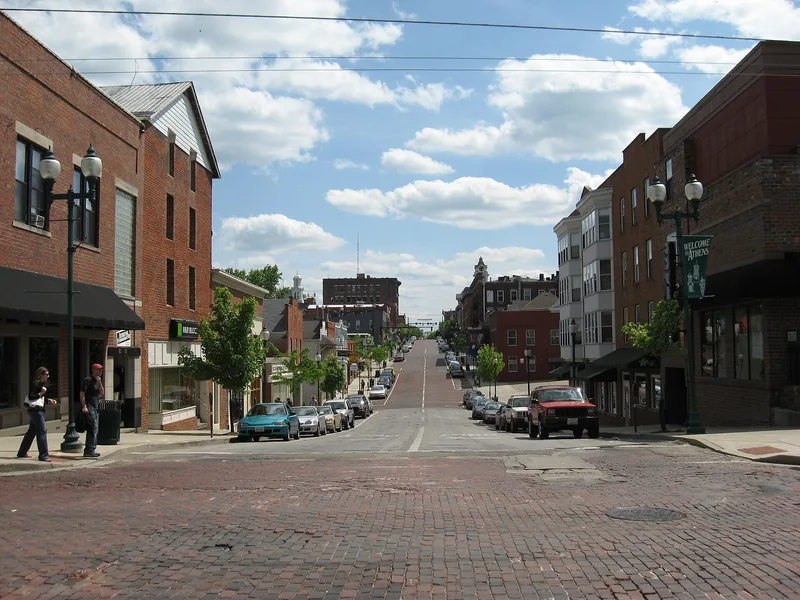
Downtown Athens, Ohio, is preserved as a historic district of 96 buildings along Court Street and four streets running east and west from it. Most date from the mid-1800s to the early 1920s and remain largely intact above the ground floor. The district includes the Athens County Courthouse of 1877-80, the 1874 Municipal Building, the Athens National Bank Building, the 1902 Presbyterian Church with Romanesque Revival influence, the early 20th century National Guard Armory with battlements, and the 1901 Junod Mill. Italianate commercial blocks, a 1917 theater with Art Deco influence, and several older houses add variety, including a frame I house probably built in the first half of the 19th century. Five modern buildings and three altered storefronts are noted as intrusions, but surrounding historic buildings limit their effect. The district is tied to a town that depended on Ohio University and to the area's mineral exploitation around 1900.
Significance in brief: The district is described as a largely intact collection of commercial, civic, religious and residential buildings that convey a strong sense of history. The truncated significance text ties it to a town dependent on Ohio University, the first university in the Northwest Territory, and to mineral exploitation in the late 1800s and early 1900s.
Machine-generated summary. This summary was generated by a language model from the official nomination document and has not been reviewed line by line by an editor. It may contain errors. Check the source document before relying on any detail. Source: nomination document (PDF) · National Archives catalog entry. NRHP reference 82003541, listed September 30, 1982. Summary generated October 2026 (model claude-sonnet-5-5, prompt v1.0-2026-10-29, confidence medium).
Key facts
| Address | N. Court St. between Carpenter and Union Sts. and Congress and College Sts., Athens |
|---|---|
| County | Athens County |
| Listed | September 30, 1982 |
| Reference number | 82003541 |
| Resource type | District |
| Architectural style | Mixed 19th and early 20th century commercial styles, including Victorian Italianate, Greek Revival, Romanesque Revival and Art Deco influences |
| Areas of significance | Commerce, Politics/Government, Architecture |
| Level of significance | Local |
| Status (as stated in the nomination) | Most buildings are described as intact, especially above the first story. There are five modern intrusions and three altered storefronts. The district is in occupied commercial, government, religious and residential use. |
| Acreage | 21.5 |
| Coordinates | 39.33091, -82.10123 (NPS GIS) |
What listing means for this property
This is a historic district. Buildings within its boundary are either contributing (they add to the district's significance) or non-contributing. Owners of contributing income-producing buildings can claim the 20% federal rehabilitation tax credit; homeowners should look at state credits. National Register districts impose no design review by themselves; a local historic district ordinance, if one exists, does (the difference explained).
General information, not legal or tax advice. Rules change; confirm with your State Historic Preservation Office or a qualified adviser.
Sources and further reading
- National Park Service, National Register of Historic Places database (snapshot May 2026), reference 82003541.
- Nomination form (PDF, National Archives) — catalog entry
- Wikipedia article (used for cross-checking only; text not reproduced here)
- Wikidata Q4813481
- This listing as JSON
Last updated October 2026. Found an error? See the editorial policy for how to report it.