Crumrine, John, Farm
Also known as: Clayland Farms; Crumrine Farms

Why it's listed
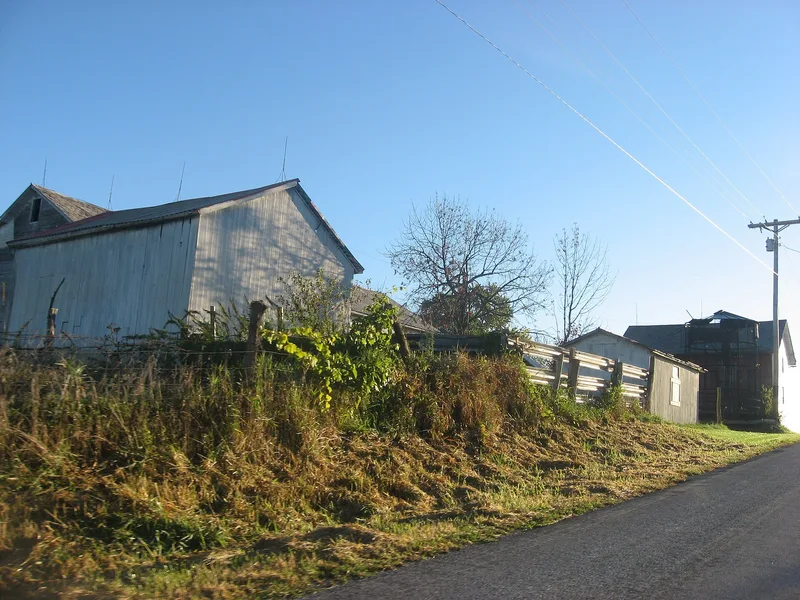
This farm near Nova, in Troy Township, Ashland County, Ohio, centers on a Greek Revival house built about 1860-62 for farm founder John Crumrine. The house is an upright-and-wing design on a stone foundation, with a front-gabled two-story section, clapboard siding, corner pilasters, a broad cornice with returns, frieze windows and a slate roof. Inside, the staircase, oak wainscoting, clock niche and original hardware survive. Thirteen outbuildings and structures remain, including a hewn-beam barn, smokehouse, granary, corncrib, chicken coop, carriage barn and early garages. Four generations of the family raised cattle, Merino sheep, chickens, hay and grain here, and the original fence lines are intact. Troy Township was settled late, and few of its Greek Revival houses escaped later alteration. Most farms also lost their older outbuildings as their uses faded. This property kept both house and outbuildings, so it illustrates the township's architecture and its farming history from the mid-1800s into the twentieth century.
Significance in brief: The farmhouse is one of the two most well-developed examples of Greek Revival architecture in Troy Township, with an almost unaltered interior. The farm is also one of the two most intact farm complexes showing the agricultural history of the township, retaining outbuildings that most other farms lost.
Machine-generated summary. This summary was generated by a language model from the official nomination document and has not been reviewed line by line by an editor. It may contain errors. Check the source document before relying on any detail. Source: nomination document (PDF) · National Archives catalog entry. NRHP reference 90001778, listed December 7, 1990. Summary generated October 2026 (model claude-sonnet-5-5, prompt v1.0-2026-10-29, confidence high).
Key facts
| Address | 792 Co. Rd. 40, Nova |
|---|---|
| County | Ashland County |
| Listed | December 7, 1990 |
| Reference number | 90001778 |
| Resource type | Building |
| Period of significance | 1860-1930 |
| Architect / builder | Unknown |
| Architectural style | Greek Revival |
| Criteria |
|
| Areas of significance | Agriculture, Architecture |
| Level of significance | Local |
| Status (as stated in the nomination) | The farm is still in use as a farm and dwelling, with its original 152 acres retained and about 60 acres added later. |
| Acreage | 140 |
| Coordinates | 41.06150, -82.28401 (NPS GIS) |
What listing means for this property
National Register listing is honorary for a privately owned home: it does not by itself restrict what an owner may do with their own money, and it does not require public access. Restrictions come from local landmark or historic-district ordinances, which are separate (how they differ).
Owner-occupied houses are not eligible for the 20% federal rehabilitation tax credit, which applies to income-producing buildings, but many states offer credits for homeowners. Listing also opens the door to preservation easements and to buying a plaque. Start with what listing means for homeowners, renovating a listed house and selling one.
General information, not legal or tax advice. Rules change; confirm with your State Historic Preservation Office or a qualified adviser.
Sources and further reading
- National Park Service, National Register of Historic Places database (snapshot May 2026), reference 90001778.
- Nomination form (PDF, National Archives) — catalog entry
- Wikidata Q137594212
- This listing as JSON
Last updated October 2026. Found an error? See the editorial policy for how to report it.