Crittenden Farm

Why it's listed
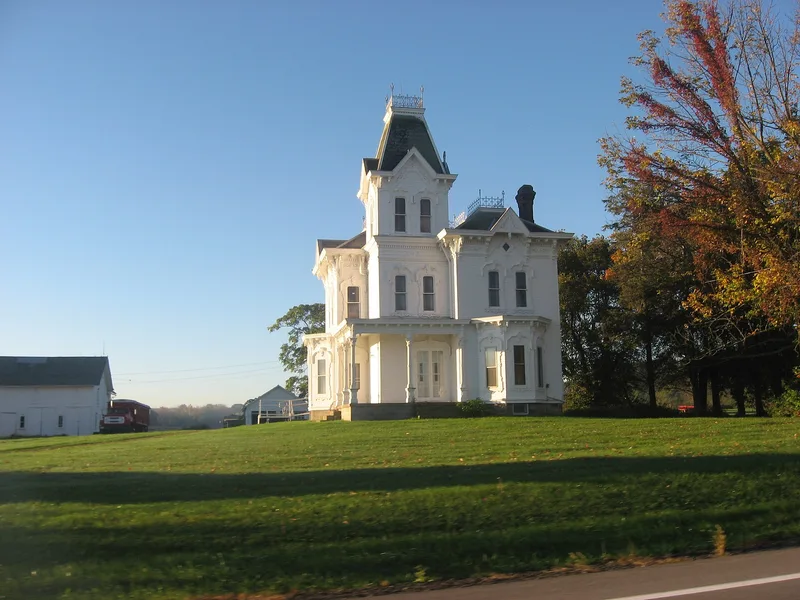
Crittenden Farm is a 665-acre working farm in western Ruggles Township, Ashland County, Ohio, bounded by U.S. Routes 224 and 250. Its gently rolling land includes pasture, cultivated fields, a twelve-acre lake behind an earthen dam, and a western woodland of beech, tulip and hickory that appears never to have been logged. Two large wooden farmhouses stand on the property. The Charles Crittenden House, dated 1878, is a Second Empire residence with a mansard tower, carved porches and an ornate cornice. The Henry Crittenden House is an Italianate home of nearly identical plan. Brothers Charles and Henry Crittenden built them after dividing their father Medad's farm in the 1870s. The land was first bought from the government land office by Nezer Sutherland, and a small stone-enclosed family cemetery holds early owners. The farm is notable for its size, its surviving virgin forest, its architecture and its unbroken form over roughly a century and a half.
Significance in brief: The nomination argues the farm is the largest single farm in Ashland County and has a well-preserved Second Empire farmhouse, perhaps North Central Ohio's largest and most ornate late nineteenth-century farmhouse. It also contains rare virgin woodland and an unusual family cemetery. The farm survives in essentially the same form as when first bought from the government land office.
Machine-generated summary. This summary was generated by a language model from the official nomination document and has not been reviewed line by line by an editor. It may contain errors. Check the source document before relying on any detail. Source: nomination document (PDF) · National Archives catalog entry. NRHP reference 82003540, listed April 22, 1982. Summary generated October 2026 (model claude-sonnet-5-5, prompt v1.0-2026-10-29, confidence medium).
Key facts
| Address | NW of Savannah on US 224 and US 250, Savannah |
|---|---|
| County | Ashland County |
| Listed | April 22, 1982 |
| Reference number | 82003540 |
| Resource type | District |
| Period of significance | 1800-1899 |
| Architect / builder | Unknown |
| Architectural style | Second Empire (Charles Crittenden House); Italianate (Henry Crittenden House) |
| Areas of significance | Architecture, Agriculture |
| Level of significance | Local |
| Status (as stated in the nomination) | Occupied and in agricultural and private residential use; the houses and cemetery are described as in good condition, with the Henry Crittenden House more altered. |
| Acreage | 665 |
| Coordinates | 41.02168, -82.41362 (NPS GIS) |
What listing means for this property
This is a historic district. Buildings within its boundary are either contributing (they add to the district's significance) or non-contributing. Owners of contributing income-producing buildings can claim the 20% federal rehabilitation tax credit; homeowners should look at state credits. National Register districts impose no design review by themselves; a local historic district ordinance, if one exists, does (the difference explained).
General information, not legal or tax advice. Rules change; confirm with your State Historic Preservation Office or a qualified adviser.
Sources and further reading
- National Park Service, National Register of Historic Places database (snapshot May 2026), reference 82003540.
- Nomination form (PDF, National Archives) — catalog entry
- Wikipedia article (used for cross-checking only; text not reproduced here)
- Wikidata Q15212013
- This listing as JSON
Last updated October 2026. Found an error? See the editorial policy for how to report it.