Second Yadkin County Jail
Also known as: Charles Bruce Davis Museum of Art,History,and Science

Why it's listed
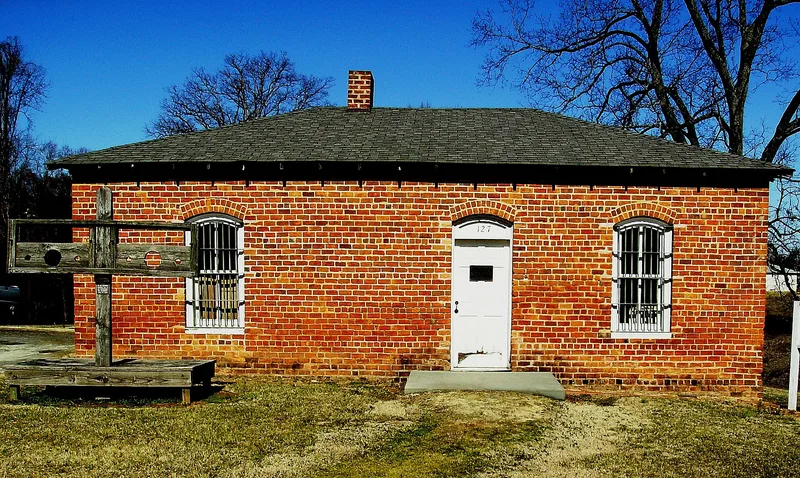
This small brick jail at the corner of East Hemlock and Van Buren streets in Yadkinville was built about 1892, after the county's first jail burned. The one-story, hip-roofed building has two rooms, one serving as the sheriff's office with two cells and the other as a "bull pen" for maximum-security prisoners. The county paid a St. Louis firm for cells and fixtures, and the metal "accordion" ceiling topped with concrete survives as an early fireproof system. The jail served until 1928, when a larger jail replaced it and the interior became apartments. The property was donated to the Yadkin County Historical Society in 1976, and later restoration removed the 1928 additions and repaired original materials. It was listed as the only government building remaining from the county's first fifty years and as a well-preserved example of an increasingly rare property type, the small county jail.
Significance in brief: The nomination argues it is the only surviving county government building from Yadkin County's first half century, supporting significance under Criterion A in Politics/Government. It is also a well-preserved example of a small county jail, a property type becoming rare in North Carolina county seats, and it has early fireproof metal and concrete construction (Criterion C).
Machine-generated summary. This summary was generated by a language model from the official nomination document and has not been reviewed line by line by an editor. It may contain errors. Check the source document before relying on any detail. Source: nomination document (PDF) · National Archives catalog entry. NRHP reference 88001113, listed July 21, 1988. Summary generated October 2026 (model claude-sonnet-5-5, prompt v1.0-2026-10-29, confidence high).
Key facts
| Address | 241 E. Hemlock St., Yadkinville |
|---|---|
| County | Yadkin County |
| Listed | July 21, 1988 |
| Reference number | 88001113 |
| Resource type | Building |
| Period of significance | ca. 1892-1928 |
| Architect / builder | Unknown |
| Architectural style | Utilitarian Vernacular |
| Criteria |
|
| Areas of significance | Politics/Government, Architecture |
| Level of significance | Local |
| Status (as stated in the nomination) | Restoration as a museum was essentially complete, with wiring and plumbing still to be done; a 1930s concrete block outbuilding is used for storage by the historical society. |
| Acreage | 0.9 |
| Coordinates | 36.13589, -80.65636 (NPS GIS) |
What listing means for this property
For a publicly owned building or structure, listing mainly matters when federal funds, permits or licences are involved: projects then go through Section 106 review so effects on the property are considered. Listing also strengthens applications for preservation grants and, for leased income-producing uses, can enable the federal rehabilitation tax credit.
General information, not legal or tax advice. Rules change; confirm with your State Historic Preservation Office or a qualified adviser.
Sources and further reading
- National Park Service, National Register of Historic Places database (snapshot May 2026), reference 88001113.
- Nomination form (PDF, National Archives) — catalog entry
- Wikipedia article (used for cross-checking only; text not reproduced here)
- Wikidata Q23302934
- This listing as JSON
Last updated October 2026. Found an error? See the editorial policy for how to report it.