Elkin Creek Mill

Why it's listed
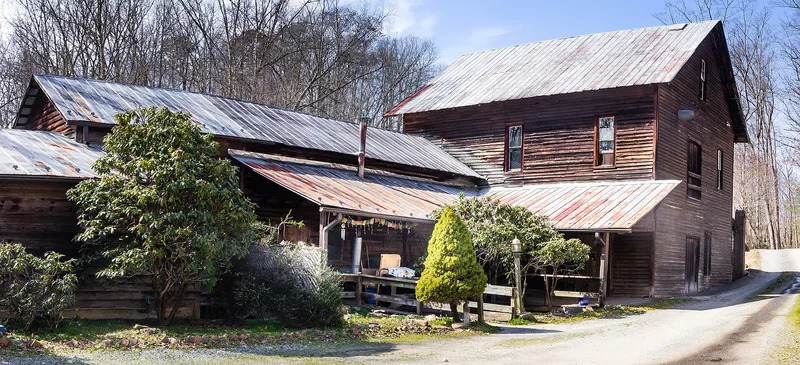
Built around 1896 on Big Elkin Creek in east Wilkes County, this simple frame mill housed three separate water-turbine systems: roller mills for flour, a millstone for cornmeal, and a hammer mill for livestock feed. Most of the machinery dates from the first decades of operation and remains in place, including cleaners, sifters, mixers and elevators, much of it made by the Sprout-Waldren Company. L. T. Stimpson and John A. Butler of Iredell County established the mill, and farmers paid for milling with a share of their grain. Later owners added renovations and auxiliary engines. Edward Jolly ran the mill from 1938 until 1970, when it could produce about 4,000 pounds of flour a day. It closed for good in the mid-1970s. The mill is notable for its remarkably complete equipment, its link to the area's farm economy, and its association with two regional industrialists. New owners planned to convert it to a restaurant.
Significance in brief: The mill keeps nearly all of its original milling equipment in place, making it one of the best examples of a full-scale water-powered milling operation in western North Carolina. It is tied to the state's traditional farm economy and to two 'New South' industrialists, L. T. Stimpson and John A. Butler. It also embodies the systems and processes used to produce flour, cornmeal and feed in the late nineteenth and early twentieth centuries.
Machine-generated summary. This summary was generated by a language model from the official nomination document and has not been reviewed line by line by an editor. It may contain errors. Check the source document before relying on any detail. Source: nomination document (PDF) · National Archives catalog entry. NRHP reference 82003521, listed April 29, 1982. Summary generated October 2026 (model claude-sonnet-5-5, prompt v1.0-2026-10-29, confidence high).
Key facts
| Address | SR 2045, West Elkin |
|---|---|
| County | Wilkes County |
| Listed | April 29, 1982 |
| Reference number | 82003521 |
| Resource type | Building |
| Period of significance | 1896 |
| Architect / builder | Unknown |
| Criteria |
|
| Areas of significance | Industry |
| Level of significance | Local |
| Status (as stated in the nomination) | Closed as a mill in the mid-1970s and damaged by vandals; at the time of nomination it was being refurbished as a restaurant, with the milling equipment to be left in place. |
| Acreage | 2.5 |
| Coordinates | 36.27796, -80.87442 (NPS GIS) |
What listing means for this property
For an income-producing building, listing (individually or as a contributing building in a district) is the gateway to the 20% federal rehabilitation tax credit on qualified rehabilitation costs, often stackable with state credits. Work claiming the credit must follow the Secretary of the Interior's Standards and be approved in advance.
Listing does not restrict a private owner acting without federal money or permits; where federal funding or licensing is involved, Section 106 review applies.
General information, not legal or tax advice. Rules change; confirm with your State Historic Preservation Office or a qualified adviser.
Sources and further reading
- National Park Service, National Register of Historic Places database (snapshot May 2026), reference 82003521.
- Nomination form (PDF, National Archives) — catalog entry
- Wikipedia article (used for cross-checking only; text not reproduced here)
- Wikidata Q20708945
- This listing as JSON
Last updated October 2026. Found an error? See the editorial policy for how to report it.