Latham House

Approximate location: the National Park Service places this pin arbitrarily within the property, not at a surveyed point (stated accuracy ±12 m).
Why it's listed
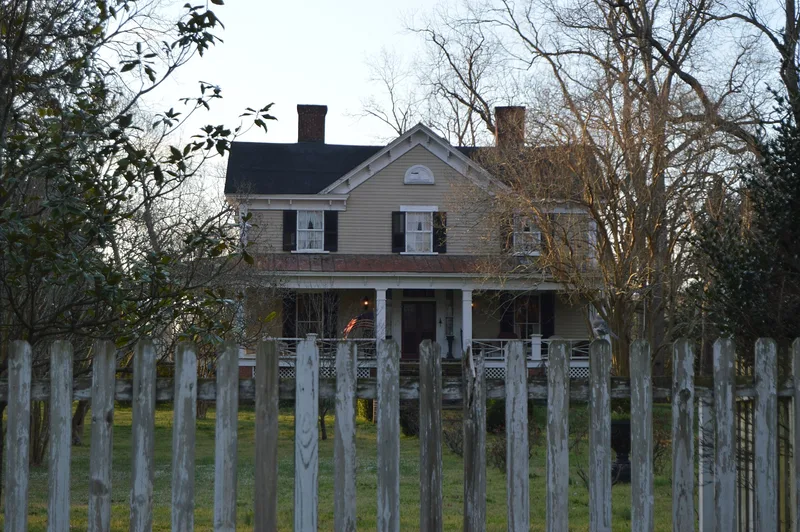
Built around 1850 for Charles Latham, a locally prominent politician, this two-story frame house at 311 East Main Street in Plymouth is a Greek Revival dwelling three bays wide and two deep. Its most unusual feature is a high brick basement, rare in coastal Washington County. The plan has a center hall with two rooms on each side, and simple fluted-strip trim repeats on corner posts, windows, doors and mantels. Later changes include Italianate-style brackets, an extended front porch with a porte-cochere, and a partition dividing the hall. The house is regarded as the town's chief domestic landmark. Local tradition says townspeople crowded into the basement during the 1864 Battle of Plymouth, and fighting reportedly took place on the lawn. Latham served as high sheriff and in the state legislature, and his son Louis served in Congress. The house passed through descendants, and at the time of listing it stood vacant while a foundation sought to buy and restore it.
Significance in brief: The house is described as Plymouth's principal domestic landmark, with a raised basement unusual for the region and bold Greek Revival finish. It was built for Charles Latham, a prominent local political figure. A strong local tradition holds that townspeople sheltered in its basement during the 1864 Battle of Plymouth.
Machine-generated summary. This summary was generated by a language model from the official nomination document and has not been reviewed line by line by an editor. It may contain errors. Check the source document before relying on any detail. Source: nomination document (PDF) · National Archives catalog entry. NRHP reference 76001348, listed December 12, 1976. Summary generated October 2026 (model claude-sonnet-5-5, prompt v1.0-2026-10-29, confidence high).
Key facts
| Address | 311 E. Main St., Plymouth |
|---|---|
| County | Washington County |
| Listed | December 12, 1976 |
| Reference number | 76001348 |
| Resource type | Building |
| Period of significance | 1800-1899 |
| Architectural style | Greek Revival |
| Areas of significance | Military, Politics/Government, Architecture |
| Level of significance | Local |
| Status (as stated in the nomination) | Listed as unoccupied and vacant at the time of nomination; a local foundation held an option to buy it and planned restoration as a community center, museum and headquarters. |
| Acreage | 2 |
| Within district | Plymouth Historic District |
| Coordinates | 35.86721, -76.74591 (NPS GIS) |
What listing means for this property
National Register listing is honorary for a privately owned home: it does not by itself restrict what an owner may do with their own money, and it does not require public access. Restrictions come from local landmark or historic-district ordinances, which are separate (how they differ).
Owner-occupied houses are not eligible for the 20% federal rehabilitation tax credit, which applies to income-producing buildings, but many states offer credits for homeowners. Listing also opens the door to preservation easements and to buying a plaque. Start with what listing means for homeowners, renovating a listed house and selling one.
Noted as vacant in the nomination. Nomination documents can be decades old; current status may differ. If you are considering buying an empty listed property, read the due-diligence checklist.
General information, not legal or tax advice. Rules change; confirm with your State Historic Preservation Office or a qualified adviser.
Sources and further reading
- National Park Service, National Register of Historic Places database (snapshot May 2026), reference 76001348.
- Nomination form (PDF, National Archives) — catalog entry
- Wikipedia article (used for cross-checking only; text not reproduced here)
- Wikidata Q20679806
- This listing as JSON
Last updated October 2026. Found an error? See the editorial policy for how to report it.