New Hill Historic District
New Hill Historic District is a historic district in New Hill, Wake County, North Carolina, listed on the National Register of Historic Places on April 25, 2001 (reference number 01000426). The National Park Service records its significance in Agriculture and Architecture at the local level.
Facts from the NPS National Register database (); nomination summary October 2026. Last updated . Sources for each fact.

The pin is a point inside the NPS boundary polygon, not a surveyed location.
Why it's listed
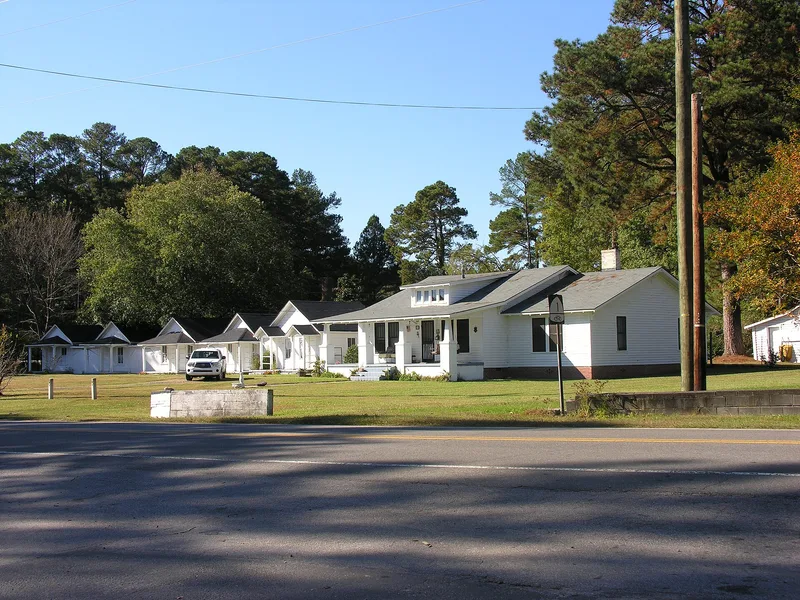
New Hill is a small crossroads community in western Wake County, North Carolina, where Old U.S. Highway 1 meets New Hill-Holleman Road. The historic district covers about 282 acres of farmland and pine woods and holds stores, houses, farmsteads, a Gothic Revival Baptist church of about 1888 with its cemetery, and a rail line. The village grew from a mid-nineteenth-century post office and the arrival of the Raleigh and Augusta Railroad, and by the 1880s it had stores, a sawmill, a cider mill and a turpentine distillery. Paving of the highway in 1928 brought motorists to the Roundy motor court and tearoom. Farmsteads with tobacco barns, including three with terra cotta tile siding, reflect the spread of bright leaf tobacco farming. Despite suburban growth nearby, the district keeps its early-to-mid-twentieth-century look and its field patterns. It was listed for its agricultural and architectural significance between 1860 and 1950.
Significance in brief: The district is described as a well-preserved and increasingly rare example of the rural crossroads communities once common in Wake County. It retains its commercial core, church, dwellings and tobacco farmsteads, which show the link between agriculture and commerce and the bright leaf tobacco transformation of the landscape. The form lists Criteria A and C and areas of significance in Agriculture and Architecture, but the surviving text says it qualifies under Criterion C.
Machine-generated summary. This summary was generated by a language model from the official nomination document and has not been reviewed line by line by an editor. It may contain errors. Check the source document before relying on any detail. Source: nomination document (PDF) · National Archives catalog entry. NRHP reference 01000426, listed April 25, 2001. Summary generated October 2026 (model claude-sonnet-5-5, prompt v1.0-2026-10-29, confidence medium).
Key facts
| Official database NPS National Register database, ref. 01000426 , checked | |
|---|---|
| Address | Roughly 0.5 S of jct. of Old US 1 and NC 1127, and 2 mi. W of jct. with Old US 1, New Hill |
| County | Wake County |
| Listed | April 25, 2001 |
| Reference number | 01000426 |
| Resource type | District |
| Areas of significance | Agriculture, Architecture |
| Level of significance | Local |
| National Historic Landmark | No |
| Acreage | 282 |
| Official document, machine-extracted Nomination form (National Archives) , checked | |
| Period of significance | 1860-1950 |
| Architect / builder | Unknown |
| Architectural style | Late Victorian, Colonial Revival, Tudor Revival, Bungalow/Craftsman, Gothic Revival |
| Criteria |
|
| Status (as stated in the nomination) | Largely intact and still rural; some resources are vacant, including the former Bright's store (vacant since the 1940s) and two corner stores (vacant since about 1960). The Roundy general store remains in operation. |
| Official dataset NPS cultural-resource GIS (NRHP locations) | |
| Coordinates | 35.67980, -78.93937 |
What listing means for this property
This is a historic district. Buildings within its boundary are either contributing (they add to the district's significance) or non-contributing. Owners of contributing income-producing buildings can claim the 20% federal rehabilitation tax credit; homeowners should look at state credits. National Register districts impose no design review by themselves; a local historic district ordinance, if one exists, does (the difference explained).
General information, not legal or tax advice. Rules change; confirm with your State Historic Preservation Office or a qualified adviser.
Questions about New Hill Historic District
When was New Hill Historic District added to the National Register of Historic Places?
New Hill Historic District was listed on April 25, 2001. Its National Register reference number is 01000426.
Is New Hill Historic District a National Historic Landmark?
No. The National Park Service database (snapshot of May 2026) lists New Hill Historic District on the National Register but does not record it as a National Historic Landmark.
Where is New Hill Historic District?
Roughly 0.5 S of jct. of Old US 1 and NC 1127, and 2 mi. W of jct. with Old US 1, New Hill, Wake County, North Carolina; coordinates 35.67980, -78.93937.
Why is New Hill Historic District historically significant?
According to a machine-generated summary of its nomination form: The district is described as a well-preserved and increasingly rare example of the rural crossroads communities once common in Wake County. It retains its commercial core, church, dwellings and tobacco farmsteads, which show the link between agriculture and commerce and the bright leaf tobacco transformation of the landscape. The form lists Criteria A and C and areas of significance in Agriculture and Architecture, but the surviving text says it qualifies under Criterion C. Check the nomination document before relying on any detail.
Who designed or built New Hill Historic District?
The nomination form names Unknown as architect or builder (extracted by machine from the nomination; check the source document).
Where can I read the original nomination for New Hill Historic District?
The nomination form is a public record held by the National Archives: nomination document (PDF).
Sources and further reading
- National Park Service, National Register of Historic Places database (snapshot May 2026), reference 01000426.
- Nomination form (PDF, National Archives) — catalog entry
- Wikipedia article (used for cross-checking only; text not reproduced here)
- Wikidata Q7008644
- This listing as JSON
Last updated November 2026. Found an error? See the editorial policy for how to report it.