Ashland
Why it's listed
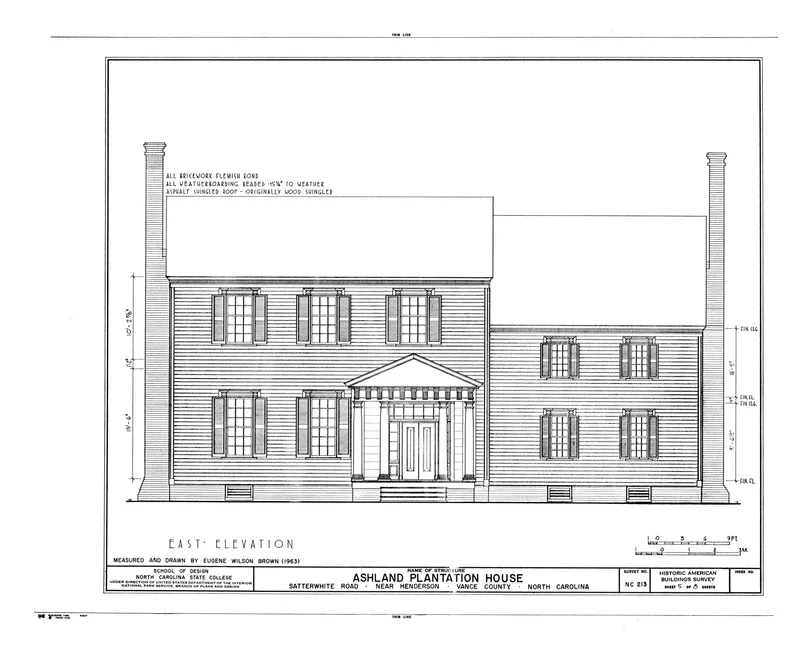
Ashland is a plantation house northwest of Henderson, reached by a boxwood walk and set on a slight rise in a yard of large trees. It consists of two frame sections side by side: a lower, older north section and a larger south section added by mid-nineteenth century owners. Beaded weatherboards, pilastered window frames, a pedimented Tuscan entrance porch and Flemish bond chimneys mark the exterior. Inside, the newer section has a wide hall divided by a transverse arch on heavy paneled pilasters, a grand stair, plaster medallions and a large front room said to have been a ballroom. Remnants in the attic and basement suggest possible eighteenth century construction in the older part. The property is linked to the Henderson family, including Richard Henderson, a judge who organized the Transylvania colony and whose house was burned, probably by Regulators, before he rebuilt. The house is regarded as Vance County's best-known antebellum showplace and landmark.
Significance in brief: The nomination calls Ashland one of the most impressive and best-maintained plantation houses in the Nutbush Creek area and Vance County's best-known antebellum showplace. It is also tied to the Henderson family, notably judge and colonizer Richard Henderson, who owned the Ashland tract and organized the Transylvania colony. The house may incorporate an earlier dwelling that was rebuilt after a fire attributed to the Regulators.
Machine-generated summary. This summary was generated by a language model from the official nomination document and has not been reviewed line by line by an editor. It may contain errors. Check the source document before relying on any detail. Source: nomination document (PDF) · National Archives catalog entry. NRHP reference 73001371, listed March 14, 1973. Summary generated October 2026 (model claude-sonnet-5-5, prompt v1.0-2026-10-29, confidence medium).
Key facts
| Address | N of Henderson on Satterwhite Point Rd., Henderson |
|---|---|
| County | Vance County |
| Listed | March 14, 1973 |
| Reference number | 73001371 |
| Resource type | Building |
| Architectural style | Greek Revival and Federal elements in the newer section |
| Areas of significance | Politics/Government, Architecture |
| Level of significance | Local |
| Status (as stated in the nomination) | Described as in excellent condition, surrounded by well-tended farmland, privately owned and used as a private residence. |
| Acreage | 10 |
| Coordinates | 36.42410, -78.36938 (NPS GIS) |
What listing means for this property
National Register listing is honorary: it recognises significance and does not restrict what a private owner may do without federal money or permits. It unlocks the 20% federal rehabilitation tax credit for income-producing buildings, state credits in many states, and Section 106 review when federal agencies are involved. See what listing means in practice.
General information, not legal or tax advice. Rules change; confirm with your State Historic Preservation Office or a qualified adviser.
Sources and further reading
- National Park Service, National Register of Historic Places database (snapshot May 2026), reference 73001371.
- Nomination form (PDF, National Archives) — catalog entry
- Wikipedia article (used for cross-checking only; text not reproduced here)
- Wikidata Q19986519
- This listing as JSON
Last updated October 2026. Found an error? See the editorial policy for how to report it.