North Carolina Granite Corporation Quarry Complex

Why it's listed
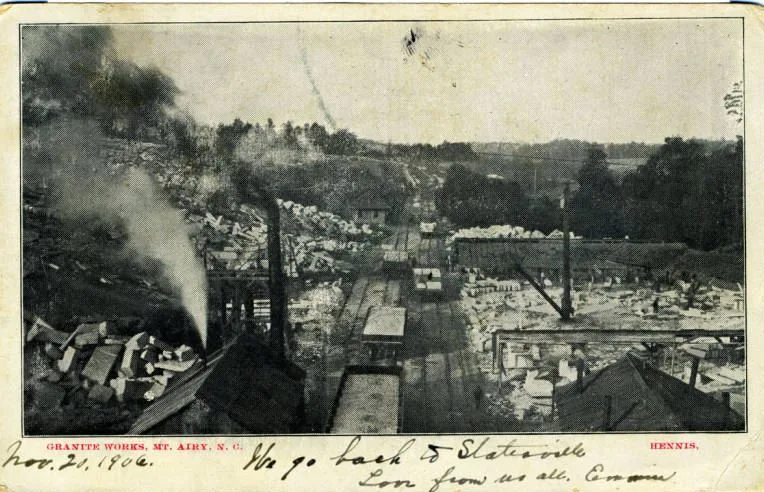
Just outside Mount Airy, North Carolina, a 266-acre industrial complex surrounds what is believed to be the world's largest open-face granite quarry, about a mile long and one-third mile wide. Quarrying began in 1889 after a railroad reached the town, and stone is still lifted from the face using confined black powder gases and the granite's natural expansion. Early buildings remain, including a 1927 frame cutting shed about 660 feet long, a 1930 saw shed, a T-shaped granite blacksmith's shop and a 1928 three-story granite office building with ornamental detail. Granite from the site was used for the Fort Knox Bullion Depository, the Arlington Memorial Bridge, the Wright Brothers Memorial and the Albert Einstein Memorial. Vermont stonecutter J. D. Sargent, company president from 1918 to 1945, built the firm into a national leader. The quarry also shaped Mount Airy's economy and its nickname, the Granite City.
Significance in brief: The nomination argues that the quarry is the largest open-face granite quarry in the world and has operated continuously since 1889. Its granite went into nationally prominent structures such as the Fort Knox Bullion Depository, the Arlington Memorial Bridge and the Wright Brothers Memorial. It is also tied to J. D. Sargent, who led the company from 1918 to 1945 and made it a national leader, and it is presented as an important industrial archeology site.
Machine-generated summary. This summary was generated by a language model from the official nomination document and has not been reviewed line by line by an editor. It may contain errors. Check the source document before relying on any detail. Source: nomination document (PDF) · National Archives catalog entry. NRHP reference 80002900, listed August 6, 1980. Summary generated October 2026 (model claude-sonnet-5-5, prompt v1.0-2026-10-29, confidence high).
Key facts
| Address | E of Mount Airy on NC 103, Mount Airy |
|---|---|
| County | Surry County |
| Listed | August 6, 1980 |
| Reference number | 80002900 |
| Resource type | District |
| Period of significance | 1900- |
| Criteria |
|
| Areas of significance | Industry |
| Level of significance | National |
| Status (as stated in the nomination) | Described as occupied and in continuous operation; the form notes that the company employs about 250 people and that several early structures continue in use. |
| Acreage | 266 |
| Coordinates | 36.51123, -80.58351 (NPS GIS) |
What listing means for this property
This is a historic district. Buildings within its boundary are either contributing (they add to the district's significance) or non-contributing. Owners of contributing income-producing buildings can claim the 20% federal rehabilitation tax credit; homeowners should look at state credits. National Register districts impose no design review by themselves; a local historic district ordinance, if one exists, does (the difference explained).
General information, not legal or tax advice. Rules change; confirm with your State Historic Preservation Office or a qualified adviser.
Sources and further reading
- National Park Service, National Register of Historic Places database (snapshot May 2026), reference 80002900.
- Nomination form (PDF, National Archives) — catalog entry
- Wikipedia article (used for cross-checking only; text not reproduced here)
- Wikidata Q19987328
- This listing as JSON
Last updated October 2026. Found an error? See the editorial policy for how to report it.