Marion House and Marion Brothers Store
Also known as: Jubal E. Marion--Firchard Nathaniel Marion House; Oakcrest
Marion House and Marion Brothers Store is a building in Siloam, Surry County, North Carolina, listed on the National Register of Historic Places on December 26, 2012 (reference number 12001090). The National Park Service records its significance in Architecture and Commerce at the local level.
Facts from the NPS National Register database (); nomination summary October 2026. Last updated . Sources for each fact.

The pin is a point inside the NPS boundary polygon, not a surveyed location.
Why it's listed
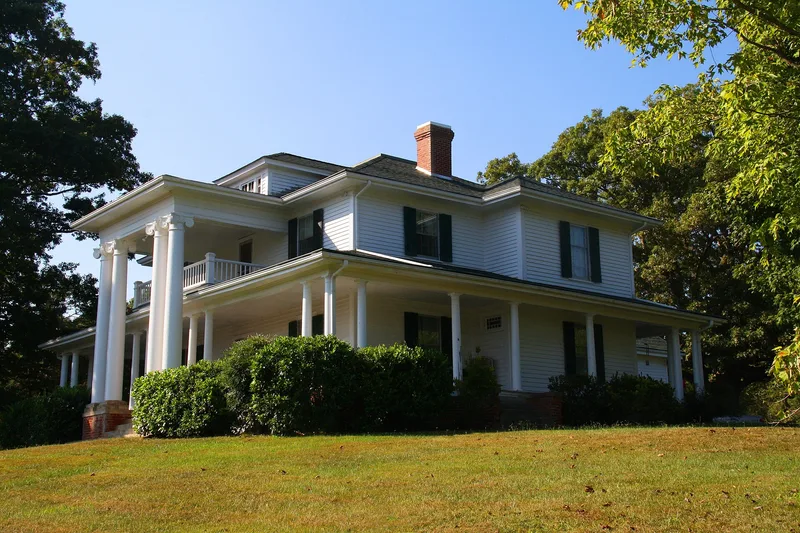
Along the north bank of the Yadkin River, the Marion House crowns a hill above cultivated bottom land. Jubal Early Marion likely built its first one-story frame section with Greek Revival details in 1861. His daughter Mollie and her husband Nat Marion remodeled it in 1895 and enlarged it to two stories in 1913 in the Neo-Classical Revival style, with a two-story Ionic portico and a wraparound Tuscan-columned porch. Winston-Salem architect Willard C. Northup is credited with the plans, though the house as built differs from them. Nearby, the brick Marion Brothers Store, built about 1894, housed a hardware store, a roller mill and living quarters. Its survival as the only brick rural store of its kind in the county, together with the house, documents the village's commercial life from the railroad's arrival in 1890 until about 1940.
Significance in brief: The house is cited as an excellent domestic example of the Neo-Classical Revival style in Surry County and the only such example in rural Surry. The Marion Brothers Store is described as the most architecturally impressive rural store of its era in the county and the only surviving brick example, reflecting the commercial growth Siloam enjoyed after the railroad arrived in 1890.
Machine-generated summary. This summary was generated by a language model from the official nomination document and has not been reviewed line by line by an editor. It may contain errors. Check the source document before relying on any detail. Source: nomination document (PDF) · National Archives catalog entry. NRHP reference 12001090, listed December 26, 2012. Summary generated October 2026 (model claude-haiku-5-5, prompt v1.1-2026-10-29, confidence high).
Key facts
| Official database NPS National Register database, ref. 12001090 , checked | |
|---|---|
| Address | 7034 Siloam Rd., Siloam |
| County | Surry County |
| Listed | December 26, 2012 |
| Reference number | 12001090 |
| Resource type | Building |
| Areas of significance | Architecture, Commerce |
| Level of significance | Local |
| National Historic Landmark | No |
| Acreage | 33 |
| Official document, machine-extracted Nomination form (National Archives) , checked | |
| Period of significance | 1861-1913 |
| Architect / builder | Willard C. Northup (architect) |
| Architectural style | Neo-Classical Revival "Southern Colonial" |
| Criteria |
|
| Status (as stated in the nomination) | The store and mill closed around 1940; the house remains in family ownership and occupancy. |
| Official dataset NPS cultural-resource GIS (NRHP locations) | |
| Coordinates | 36.28707, -80.56407 |
What listing means for this property
National Register listing is honorary for a privately owned home: it does not by itself restrict what an owner may do with their own money, and it does not require public access. Restrictions come from local landmark or historic-district ordinances, which are separate (how they differ).
Owner-occupied houses are not eligible for the 20% federal rehabilitation tax credit, which applies to income-producing buildings, but many states offer credits for homeowners. Listing also opens the door to preservation easements and to buying a plaque. Start with what listing means for homeowners, renovating a listed house and selling one.
General information, not legal or tax advice. Rules change; confirm with your State Historic Preservation Office or a qualified adviser.
Questions about Marion House and Marion Brothers Store
When was Marion House and Marion Brothers Store added to the National Register of Historic Places?
Marion House and Marion Brothers Store was listed on December 26, 2012. Its National Register reference number is 12001090.
Is Marion House and Marion Brothers Store a National Historic Landmark?
No. The National Park Service database (snapshot of May 2026) lists Marion House and Marion Brothers Store on the National Register but does not record it as a National Historic Landmark.
Where is Marion House and Marion Brothers Store?
7034 Siloam Rd., Siloam, Surry County, North Carolina; coordinates 36.28707, -80.56407.
Why is Marion House and Marion Brothers Store historically significant?
According to a machine-generated summary of its nomination form: The house is cited as an excellent domestic example of the Neo-Classical Revival style in Surry County and the only such example in rural Surry. The Marion Brothers Store is described as the most architecturally impressive rural store of its era in the county and the only surviving brick example, reflecting the commercial growth Siloam enjoyed after the railroad arrived in 1890. Check the nomination document before relying on any detail.
Who designed or built Marion House and Marion Brothers Store?
The nomination form names Willard C. Northup (architect) as architect or builder (extracted by machine from the nomination; check the source document).
Where can I read the original nomination for Marion House and Marion Brothers Store?
The nomination form is a public record held by the National Archives: nomination document (PDF).
Sources and further reading
- National Park Service, National Register of Historic Places database (snapshot May 2026), reference 12001090.
- Nomination form (PDF, National Archives) — catalog entry
- Wikipedia article (used for cross-checking only; text not reproduced here)
- Wikidata Q21188450
- This listing as JSON
Last updated November 2026. Found an error? See the editorial policy for how to report it.