Laurel Hill Presbyterian Church

Why it's listed
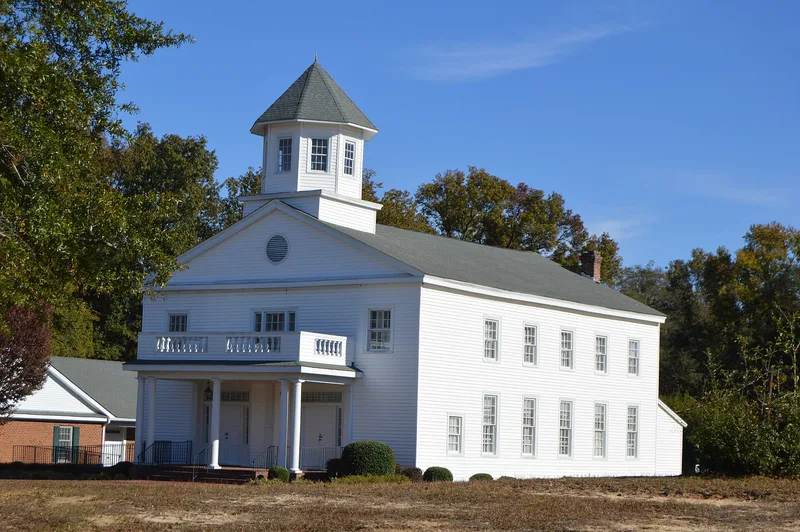
Laurel Hill Presbyterian Church, a weatherboarded gable front building completed in 1856 at a cost of $2,700, stands in a grove of water oak and magnolia at a crossroads in Scotland County, North Carolina. It is the third church erected for a congregation of Highland Scots Presbyterians that has met on the site since the eighteenth century, and it served as the centre of both worship and community life, hosting the Scotch Fair until 1871. The land was given by Duncan McFarland, a planter and politician who later served in the Ninth U.S. Congress. The church is regarded as an important, largely intact example of vernacular Greek Revival ecclesiastical architecture and the oldest church building in the county. Its interior retains a double aisle plan and an original gallery. General William T. Sherman used the church as a headquarters in March 1865, before the Battle of Bentonville. The grounds also include a study moved from the farm of Rev. Angus N. Ferguson, minister from 1871 until 1906.
Significance in brief: The nomination argues the church is an important, largely intact example of vernacular Greek Revival ecclesiastical architecture and the oldest church building in Scotland County. It is also significant as the religious and social centre of a Highland Scots Presbyterian congregation dating to the eighteenth century, and for its association with Duncan McFarland and Rev. Angus N. Ferguson.
Machine-generated summary. This summary was generated by a language model from the official nomination document and has not been reviewed line by line by an editor. It may contain errors. Check the source document before relying on any detail. Source: nomination document (PDF) · National Archives catalog entry. NRHP reference 83001915, listed August 18, 1983. Summary generated October 2026 (model claude-haiku-5-5, prompt v1.1-2026-10-29, confidence high).
Key facts
| Address | SR 1321 and SR 1323, Laurinburg |
|---|---|
| County | Scotland County |
| Listed | August 18, 1983 |
| Reference number | 83001915 |
| Resource type | Building |
| Period of significance | 1856 |
| Architectural style | Greek Revival |
| Criteria |
|
| Areas of significance | European, Architecture |
| Level of significance | Local |
| Status (as stated in the nomination) | The 1983 fire destroyed the two-story educational building, and the Community Hut and manse are described in the document as in use for church and residential purposes. |
| Acreage | 12 |
| Coordinates | 34.83265, -79.46411 (NPS GIS) |
What listing means for this property
Religious properties are listed for their architectural or historical significance, not their religious use. Listing is honorary and does not restrict the congregation's use of the building. The federal rehabilitation credit is generally unavailable unless part of the building is income-producing; some state programmes and preservation grants do cover religious buildings. Federal funding or permits trigger Section 106 review.
General information, not legal or tax advice. Rules change; confirm with your State Historic Preservation Office or a qualified adviser.
Sources and further reading
- National Park Service, National Register of Historic Places database (snapshot May 2026), reference 83001915.
- Nomination form (PDF, National Archives) — catalog entry
- Wikipedia article (used for cross-checking only; text not reproduced here)
- Wikidata Q6499861
- This listing as JSON
Last updated October 2026. Found an error? See the editorial policy for how to report it.