Pugh, Francis, House

Why it's listed
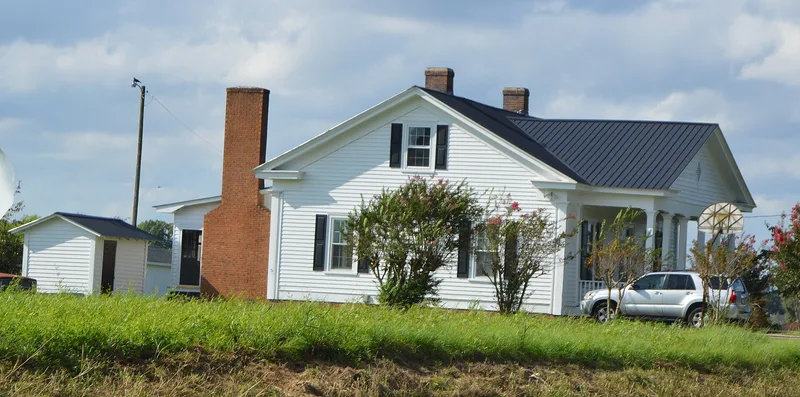
Built about 1850, this one-story weatherboarded house east of Clinton was the centerpiece of one of Sampson County's largest plantations, owned by Francis Pugh. It stands on land given to Pugh's wife, Mary Ann Kirby Pugh, by her father, William Kirby, and is believed to be part of Col. John Sampson's former Sampson Hall Plantation. Its large pillared porch under the front gable is the earliest known example of a form that dominated the county's rural Greek Revival houses from about 1850 to 1900. Census records show Pugh holding about 1,300 to 1,400 acres and 24 to 33 slaves while raising cotton, corn and livestock. The house passed to his son James after the Civil War, was restored in 1972 for an antique store, and has since been altered inside with a rear den addition. It was listed as a representative planter's farmhouse and an outstanding example of its regional porch type.
Significance in brief: The nomination calls it the earliest known example of Sampson County's bold gable-front porch form, which became the dominant rural Greek Revival house type from about 1850 to 1900. It represents the substantial dwellings built by planters in the prosperous decades before the Civil War. It also stands on part of the former Sampson Hall Plantation of Col. John Sampson.
Machine-generated summary. This summary was generated by a language model from the official nomination document and has not been reviewed line by line by an editor. It may contain errors. Check the source document before relying on any detail. Source: nomination document (PDF) · National Archives catalog entry. NRHP reference 86000577, listed March 17, 1986. Summary generated October 2026 (model claude-sonnet-5-5, prompt v1.0-2026-10-29, confidence high).
Key facts
| Address | SR 1751 at NC 403, Clinton |
|---|---|
| County | Sampson County |
| Listed | March 17, 1986 |
| Reference number | 86000577 |
| Resource type | Building |
| Period of significance | 1800-1899 |
| Architect / builder | Unknown |
| Architectural style | Greek Revival |
| Criteria |
|
| Areas of significance | Agriculture, Architecture |
| Level of significance | Local |
| Status (as stated in the nomination) | Occupied private residence, altered by renovations since 1975 and restored in 1972; the form lists its condition as excellent. |
| Acreage | 0.9 |
| Coordinates | 35.00953, -78.30210 (NPS GIS) |
What listing means for this property
National Register listing is honorary for a privately owned home: it does not by itself restrict what an owner may do with their own money, and it does not require public access. Restrictions come from local landmark or historic-district ordinances, which are separate (how they differ).
Owner-occupied houses are not eligible for the 20% federal rehabilitation tax credit, which applies to income-producing buildings, but many states offer credits for homeowners. Listing also opens the door to preservation easements and to buying a plaque. Start with what listing means for homeowners, renovating a listed house and selling one.
General information, not legal or tax advice. Rules change; confirm with your State Historic Preservation Office or a qualified adviser.
Sources and further reading
- National Park Service, National Register of Historic Places database (snapshot May 2026), reference 86000577.
- Nomination form (PDF, National Archives) — catalog entry
- Wikipedia article (used for cross-checking only; text not reproduced here)
- Wikidata Q23073319
- This listing as JSON
Last updated October 2026. Found an error? See the editorial policy for how to report it.