Kerr Mill

Why it's listed
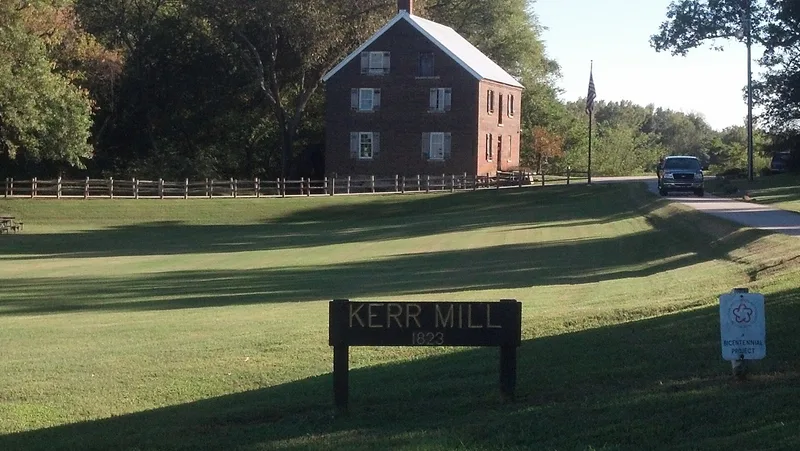
Kerr Mill is a two-story brick grist mill in a wide creek bottom near Millbridge, Rowan County. Three bays wide and two deep, it rests on a stone foundation that opens to a full basement on the creek side. The brick is laid in four-to-one bond, with molded brick cornices, gauged brick flat arches and a board-and-batten Dutch door at the center of the front. Inside, sawn and chamfered timber framing and exposed brick walls survive, along with milling equipment on every level. The mill was probably built between 1820 and 1824 for Joseph Kerr and was later run by his son, Dr. Samuel Kerr, who was a physician, farmer and state senator. In 1850 it produced 360 barrels of flour and 3,000 bushels of corn meal, and in 1860 it produced 1,500 barrels of flour. It operated until the 1940s. It is listed as one of the few brick antebellum grist mills in North Carolina, and local preservation was planned.
Significance in brief: The nomination calls it an unusually handsome and substantial brick grist mill, one of the few brick antebellum grist mills in the state. It was run by Dr. Samuel Kerr through much of the nineteenth century and produced large quantities of flour and corn meal in 1850 and 1860. It operated until the 1940s.
Machine-generated summary. This summary was generated by a language model from the official nomination document and has not been reviewed line by line by an editor. It may contain errors. Check the source document before relying on any detail. Source: nomination document (PDF) · National Archives catalog entry. NRHP reference 76001337, listed May 11, 1976. Summary generated October 2026 (model claude-sonnet-5-5, prompt v1.0-2026-10-29, confidence medium).
Key facts
| Address | W of Mill Bridge on Sloan Rd., S of NC 1768, Mill Bridge |
|---|---|
| County | Rowan County |
| Listed | May 11, 1976 |
| Reference number | 76001337 |
| Resource type | Building |
| Architectural style | Federal elements |
| Areas of significance | Industry, Architecture |
| Level of significance | State |
| Status (as stated in the nomination) | Mill is not in working order; it was used for office and storage space after the 1940s, and local restoration was planned. The form checks the property as unoccupied. |
| Acreage | 6 |
| Coordinates | 35.51985, -80.42229 (NPS GIS) |
What listing means for this property
For an income-producing building, listing (individually or as a contributing building in a district) is the gateway to the 20% federal rehabilitation tax credit on qualified rehabilitation costs, often stackable with state credits. Work claiming the credit must follow the Secretary of the Interior's Standards and be approved in advance.
Listing does not restrict a private owner acting without federal money or permits; where federal funding or licensing is involved, Section 106 review applies.
Noted as vacant in the nomination. Nomination documents can be decades old; current status may differ. If you are considering buying an empty listed property, read the due-diligence checklist.
General information, not legal or tax advice. Rules change; confirm with your State Historic Preservation Office or a qualified adviser.
Sources and further reading
- National Park Service, National Register of Historic Places database (snapshot May 2026), reference 76001337.
- Nomination form (PDF, National Archives) — catalog entry
- Wikipedia article (used for cross-checking only; text not reproduced here)
- Wikidata Q19864273
- This listing as JSON
Last updated October 2026. Found an error? See the editorial policy for how to report it.