Covington Plantation House
Also known as: Covington,John Wall,House

Why it's listed
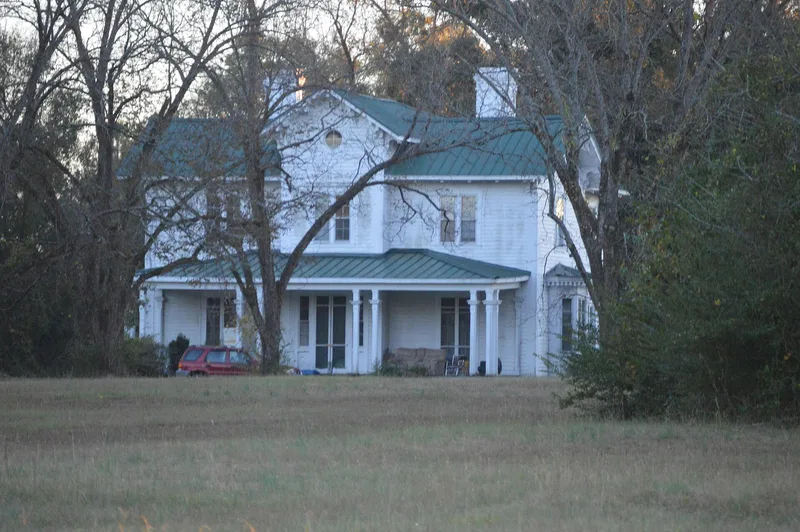
Covington Plantation House is a two-story, three-bay frame Italianate villa about four miles south of Rockingham in Richmond County, North Carolina. It probably dates from the 1850s and was built for John Wall Covington, a prosperous planter who owned nearly 2,000 acres in 1850 and worked his estate with 51 slaves. The house has bracketed gable roofs, wide eaves, paired windows, and a projecting central pavilion with a deep porch on paired chamfered posts. Its interior has a central hall, formal parlors with finely molded plaster cornices, and nine matching mantels. The house is listed for its architecture, as a well-preserved example of the Italianate villa farm house popular before the Civil War and shaped by A. J. Downing's pattern books. It is also listed for its connection to an agricultural landscape that has kept its rural character, with the house, fields, and family ownership largely intact since the nineteenth century.
Significance in brief: The nomination argues the house is a fine example of the Italianate villa farm houses popular in the antebellum era, reflecting the influence of A. J. Downing's pattern books. It cites its well-preserved woodwork, plaster moldings and cornices, and its intact rural agricultural setting, and associates it with the Covington family, prominent planters in antebellum Richmond County.
Machine-generated summary. This summary was generated by a language model from the official nomination document and has not been reviewed line by line by an editor. It may contain errors. Check the source document before relying on any detail. Source: nomination document (PDF) · National Archives catalog entry. NRHP reference 80002897, listed May 28, 1980. Summary generated October 2026 (model claude-haiku-5-5, prompt v1.1-2026-10-29, confidence high).
Key facts
| Address | SW of Rockingham, Rockingham |
|---|---|
| County | Richmond County |
| Listed | May 28, 1980 |
| Reference number | 80002897 |
| Resource type | Building |
| Period of significance | 1850-1899 |
| Architectural style | Italianate |
| Criteria |
|
| Areas of significance | Architecture |
| Level of significance | Local |
| Status (as stated in the nomination) | Good condition; the house remains in family ownership and the farm is still under cultivation. |
| Acreage | 14.4 |
| Coordinates | 34.89702, -79.80347 (NPS GIS) |
What listing means for this property
National Register listing is honorary for a privately owned home: it does not by itself restrict what an owner may do with their own money, and it does not require public access. Restrictions come from local landmark or historic-district ordinances, which are separate (how they differ).
Owner-occupied houses are not eligible for the 20% federal rehabilitation tax credit, which applies to income-producing buildings, but many states offer credits for homeowners. Listing also opens the door to preservation easements and to buying a plaque. Start with what listing means for homeowners, renovating a listed house and selling one.
General information, not legal or tax advice. Rules change; confirm with your State Historic Preservation Office or a qualified adviser.
Sources and further reading
- National Park Service, National Register of Historic Places database (snapshot May 2026), reference 80002897.
- Nomination form (PDF, National Archives) — catalog entry
- Wikipedia article (used for cross-checking only; text not reproduced here)
- Wikidata Q19872348
- This listing as JSON
Last updated October 2026. Found an error? See the editorial policy for how to report it.