Marley House

The pin is a point inside the NPS boundary polygon, not a surveyed location.
Why it's listed
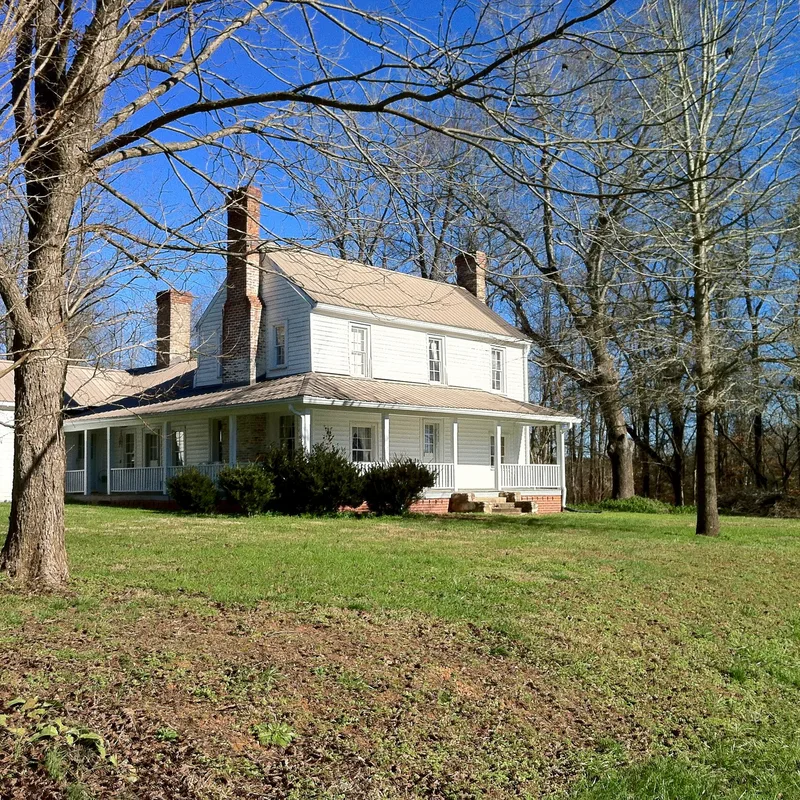
Built in stages beginning around 1816 for Thomas Marley, this two-story frame and log farmhouse sits beside the old Raleigh to Salisbury road in eastern Randolph County, near Brush Creek. Its earliest section was a single log pen with a loft, later extended to two full stories in the 1830s and 1840s, with a rear wing added in the 1840s or 1850s and a porch and rear room about 1920. Interior details include a Georgian mantel, beaded ceiling joists, and Baldwin Patent cast-iron hinges that help date the work. The property is also linked by family tradition to a stagecoach stop, supported by a post office established at Marley's Mills in 1827 and an 1838 map showing the road. Its farm, mill dam, and store illustrate the antebellum economy of the area, and the house is valued as a rare survivor of its vernacular type in the county.
Significance in brief: The nomination argues the house is significant for a long-standing local and family tradition that Thomas Marley ran a rural stagecoach stop on the Raleigh to Salisbury route, a building type rarely identified in North Carolina. It is also presented as a substantially intact example of vernacular dwellings in eastern Randolph and western Chatham counties, showing how the house was updated and expanded over time.
Machine-generated summary. This summary was generated by a language model from the official nomination document and has not been reviewed line by line by an editor. It may contain errors. Check the source document before relying on any detail. Source: nomination document (PDF) · National Archives catalog entry. NRHP reference 90001919, listed December 18, 1990. Summary generated October 2026 (model claude-haiku-5-5, prompt v1.1-2026-10-29, confidence medium).
Key facts
| Address | N side of US 64 .1 mi. W of jct. with SR 2475, Staley |
|---|---|
| County | Randolph County |
| Listed | December 18, 1990 |
| Reference number | 90001919 |
| Resource type | Building |
| Period of significance | Ca. 1816-Ca. 1920 |
| Architectural style | Vernacular, with Late Georgian, Federal and Late Federal elements; Greek Revival and Italianate details in the store |
| Criteria |
|
| Areas of significance | Transportation, Architecture |
| Level of significance | Local |
| Status (as stated in the nomination) | Marley Store is in ruinous condition; the house has been restored in part by its present owners |
| Acreage | 12 |
| Coordinates | 35.74435, -79.55047 (NPS GIS) |
What listing means for this property
National Register listing is honorary for a privately owned home: it does not by itself restrict what an owner may do with their own money, and it does not require public access. Restrictions come from local landmark or historic-district ordinances, which are separate (how they differ).
Owner-occupied houses are not eligible for the 20% federal rehabilitation tax credit, which applies to income-producing buildings, but many states offer credits for homeowners. Listing also opens the door to preservation easements and to buying a plaque. Start with what listing means for homeowners, renovating a listed house and selling one.
General information, not legal or tax advice. Rules change; confirm with your State Historic Preservation Office or a qualified adviser.
Sources and further reading
- National Park Service, National Register of Historic Places database (snapshot May 2026), reference 90001919.
- Nomination form (PDF, National Archives) — catalog entry
- Wikipedia article (used for cross-checking only; text not reproduced here)
- Wikidata Q19986953
- This listing as JSON
Last updated October 2026. Found an error? See the editorial policy for how to report it.