Lewis-Thornburg Farm
Also known as: Thornburg Farm

Why it's listed
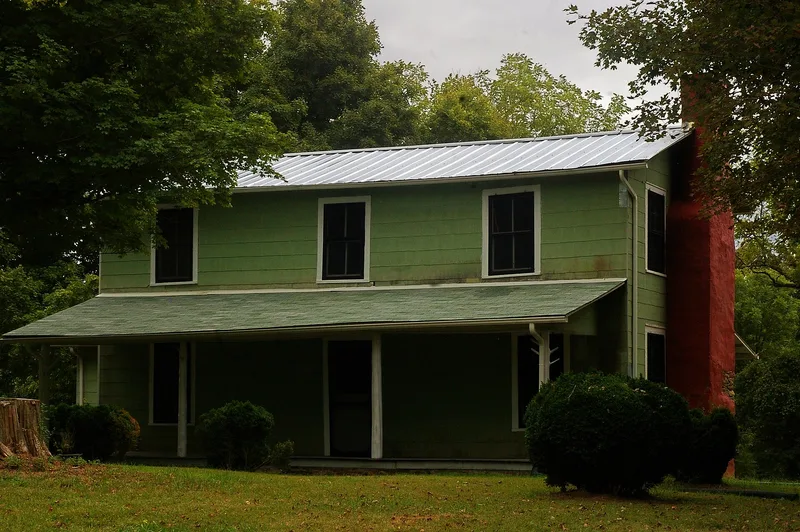
Lewis-Thornburg Farm is a 160.8-acre farmstead in southwestern Randolph County, North Carolina. Its two-story frame farmhouse dates to about 1855 and began as a one-room log-sill dwelling. It was enlarged in the late nineteenth century to add a center stair hall and extra rooms, and again in the early twentieth century with a rear ell and kitchen wing. Later owners, Madge and Marshall Thornburg, modernized the house after 1945. Around it stand barns, chicken houses, a smokehouse, a carriage house, equipment sheds, grape arbors and other structures, most dating from about 1900 to 1950. The arrangement places domestic buildings close to the house and crop, livestock and poultry buildings farther away, reflecting a diversified, efficient farm. The Lewis family shifted toward more poultry and varied crops in the early twentieth century. The farm was recognized for its agricultural history and for the layered architecture of its house. It is now managed by the Forest Service and open to the public.
Significance in brief: The nomination argues the farm is significant in agriculture and architecture. The house evolved through several building phases, and the outbuildings show the layout of a diversified, progressive Piedmont farm from 1855 to about 1950. The complex retains its barn, chicken houses, smokehouse, carriage house and other support buildings.
Machine-generated summary. This summary was generated by a language model from the official nomination document and has not been reviewed line by line by an editor. It may contain errors. Check the source document before relying on any detail. Source: nomination document (PDF) · National Archives catalog entry. NRHP reference 05000085, listed February 24, 2005. Summary generated October 2026 (model claude-sonnet-5-5, prompt v1.0-2026-10-29, confidence medium).
Key facts
| Address | NC 1107, approx 1.5 mi. S of jct. with NC 1170, Asheboro |
|---|---|
| County | Randolph County |
| Listed | February 24, 2005 |
| Reference number | 05000085 |
| Resource type | Building |
| Period of significance | 1855-circa 1950 |
| Architectural style | Center-passage, single-pile house (vernacular farmhouse) |
| Criteria |
|
| Areas of significance | Agriculture, Architecture |
| Level of significance | Local |
| Status (as stated in the nomination) | Current function is listed as vacant/not in use. The property is now managed by the Forest Service, providing public access to hiking trails and hunting lands of the Birkhead Mountains Wilderness. Some fields are still planted in hay, soybeans and dove wheat by local farmers. |
| Acreage | 160.8 |
| Coordinates | 35.61398, -79.94461 (NPS GIS) |
What listing means for this property
National Register listing is honorary for a privately owned home: it does not by itself restrict what an owner may do with their own money, and it does not require public access. Restrictions come from local landmark or historic-district ordinances, which are separate (how they differ).
Owner-occupied houses are not eligible for the 20% federal rehabilitation tax credit, which applies to income-producing buildings, but many states offer credits for homeowners. Listing also opens the door to preservation easements and to buying a plaque. Start with what listing means for homeowners, renovating a listed house and selling one.
Noted as vacant in the nomination. Nomination documents can be decades old; current status may differ. If you are considering buying an empty listed property, read the due-diligence checklist.
General information, not legal or tax advice. Rules change; confirm with your State Historic Preservation Office or a qualified adviser.
Sources and further reading
- National Park Service, National Register of Historic Places database (snapshot May 2026), reference 05000085.
- Nomination form (PDF, National Archives) — catalog entry
- Wikipedia article (used for cross-checking only; text not reproduced here)
- Wikidata Q19986782
- This listing as JSON
Last updated October 2026. Found an error? See the editorial policy for how to report it.