Kindley, Wilson, Farm and Kindley Mine
Also known as: Kindley,Wilson,House; Kindley

Why it's listed
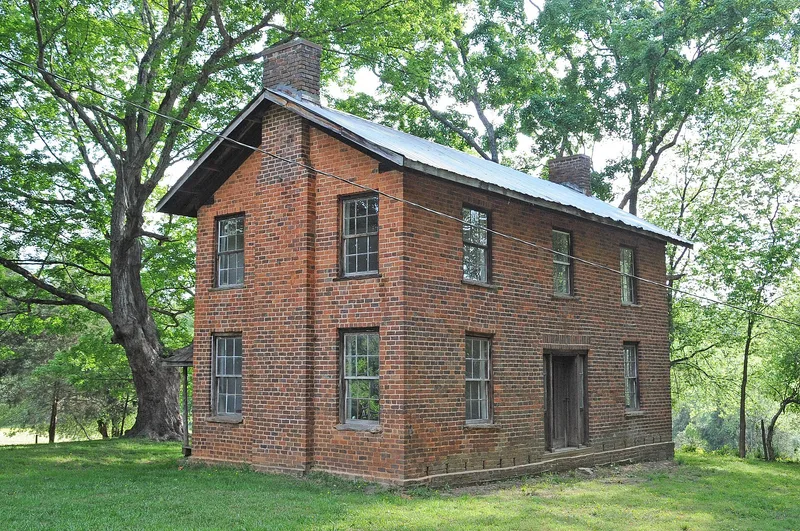
Built about 1873 in Tabernacle Township, the Wilson Kindley House is a two-story, single-pile, center-hall brick farmhouse set on a farm in the western hills of Randolph County. Family tradition holds that Wilson Kindley made the bricks himself. The house has six-over-six sash windows, wide side-lighted entrances with two-panel doors, and deep eaves with exposed rafter ends. The nomination regards it as a rare example of a brick I-house in the county, and one of very few brick houses built there after the Civil War. Nearby, a mine dug from the farm's clay pits produced gold in the 1870s and 1880s. It has placer pits and a tunnel about 125 feet long, and it was listed in an 1883 directory and was still operating in 1897. The farm and mine together show how farmers in the Piedmont also worked gold deposits.
Significance in brief: The nomination argues the farmhouse is a rare Randolph County example of a brick I-house in late Greek Revival style, with a post-bellum date and few comparable domestic brick buildings in the county. It argues the Kindley Mine is a surviving example of small farm-based gold mining in the nineteenth century Piedmont, with its placer pits, tunnel and relationship to the farm still visible.
Machine-generated summary. This summary was generated by a language model from the official nomination document and has not been reviewed line by line by an editor. It may contain errors. Check the source document before relying on any detail. Source: nomination document (PDF) · National Archives catalog entry. NRHP reference 91001412, listed June 11, 1992. Summary generated October 2026 (model claude-haiku-5-5, prompt v1.1-2026-10-29, confidence high).
Key facts
| Address | NC 1408, E side, 1 mi. N of US 64, Asheboro |
|---|---|
| County | Randolph County |
| Listed | June 11, 1992 |
| Reference number | 91001412 |
| Resource type | District |
| Period of significance | ca. 1873-1897 |
| Architectural style | Greek Revival |
| Criteria |
|
| Areas of significance | Industry, Architecture |
| Level of significance | State, Local |
| Acreage | 43.3 |
| Coordinates | 35.74721, -79.96981 (NPS GIS) |
What listing means for this property
This is a historic district. Buildings within its boundary are either contributing (they add to the district's significance) or non-contributing. Owners of contributing income-producing buildings can claim the 20% federal rehabilitation tax credit; homeowners should look at state credits. National Register districts impose no design review by themselves; a local historic district ordinance, if one exists, does (the difference explained).
General information, not legal or tax advice. Rules change; confirm with your State Historic Preservation Office or a qualified adviser.
Sources and further reading
- National Park Service, National Register of Historic Places database (snapshot May 2026), reference 91001412.
- Nomination form (PDF, National Archives) — catalog entry
- Wikipedia article (used for cross-checking only; text not reproduced here)
- Wikidata Q19864486
- This listing as JSON
Last updated October 2026. Found an error? See the editorial policy for how to report it.