Jones, Rev. Joshua D., House
Jones, Rev. Joshua D., House is a building in Mill Spring, Polk County, North Carolina, listed on the National Register of Historic Places on September 26, 1991 (reference number 91001476). The National Park Service records its significance in Black at the local level.
Facts from the NPS National Register database (); nomination summary October 2026. Last updated . Sources for each fact.

Approximate location: the National Park Service places this pin arbitrarily within the property, not at a surveyed point (stated accuracy ±12 m).
Why it's listed
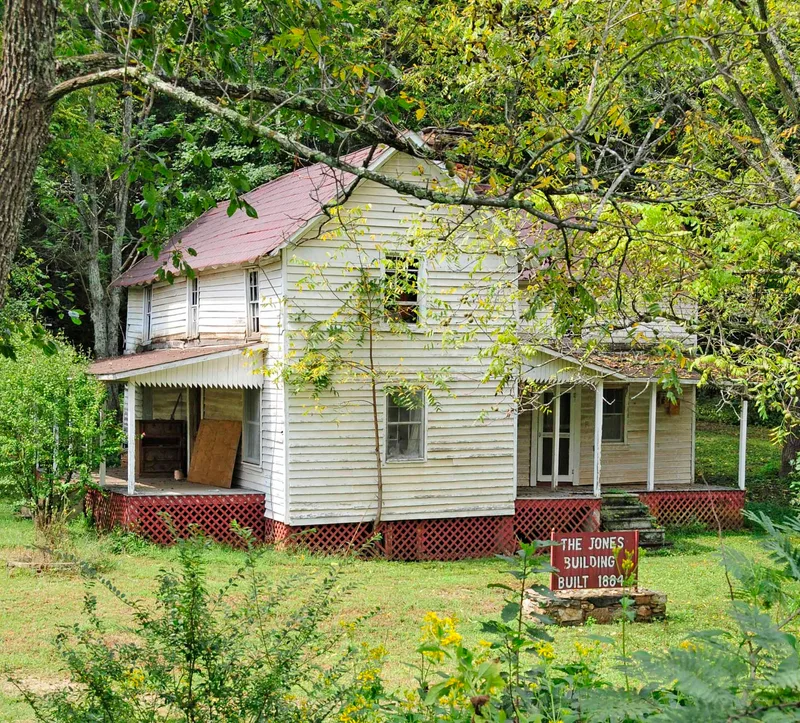
Rev. Joshua D. Jones House is a two-story frame I-house with a rear ell in the Stony Knoll community near Mill Spring, Polk County, North Carolina. Jones, born in 1858, bought the property in 1883, probably including a two-room house with attic. In 1897 he added two rooms and a full second floor, then covered the whole building in new weatherboard. A small frame store he built about 1900 stands between the house and Fox Mountain Road. Jones farmed, worked as a carpenter, kept the store, taught, and served as pastor of the Stony Knoll Colored Methodist Church. He bought land in a community of other African-Americans, reflecting the Reconstruction-era effort to own land and live among kin. After the property was sold in 1926 the interior declined, and some features were lost. The house later served as a church parsonage and community library. It was listed for its association with African-American ethnic heritage in Polk County.
Significance in brief: The house and site illustrate the post-Civil War struggle of African-Americans to own land, live in communities of their own, and work through their church to improve their lives. Rev. Joshua D. Jones was a pastor of the Colored Methodist Church, a carpenter, merchant, farmer and teacher. The house is the only substantial structure in the Stony Knoll community and a symbol of Polk County's ethnic heritage.
Machine-generated summary. This summary was generated by a language model from the official nomination document and has not been reviewed line by line by an editor. It may contain errors. Check the source document before relying on any detail. Source: nomination document (PDF) · National Archives catalog entry. NRHP reference 91001476, listed September 26, 1991. Summary generated October 2026 (model claude-sonnet-5-5, prompt v1.0-2026-10-29, confidence high).
Key facts
| Official database NPS National Register database, ref. 91001476 , checked | |
|---|---|
| Address | NC 1526 S side, 0.4 mi. from NC 108, Mill Spring |
| County | Polk County |
| Listed | September 26, 1991 |
| Reference number | 91001476 |
| Resource type | Building |
| Areas of significance | Black |
| Level of significance | Local |
| National Historic Landmark | No |
| Acreage | 2 |
| Official document, machine-extracted Nomination form (National Archives) , checked | |
| Period of significance | 1833-1926 |
| Architect / builder | Jones, Rev. Joshua D. |
| Architectural style | 19th-century I-house |
| Criteria |
|
| Status (as stated in the nomination) | Still used as a single dwelling; the interior has suffered from neglect, the second floor is used for storage, and the well-house and a boxed stair have been removed. |
| Official dataset NPS cultural-resource GIS (NRHP locations) | |
| Coordinates | 35.29024, -82.16388 |
What listing means for this property
National Register listing is honorary for a privately owned home: it does not by itself restrict what an owner may do with their own money, and it does not require public access. Restrictions come from local landmark or historic-district ordinances, which are separate (how they differ).
Owner-occupied houses are not eligible for the 20% federal rehabilitation tax credit, which applies to income-producing buildings, but many states offer credits for homeowners. Listing also opens the door to preservation easements and to buying a plaque. Start with what listing means for homeowners, renovating a listed house and selling one.
General information, not legal or tax advice. Rules change; confirm with your State Historic Preservation Office or a qualified adviser.
Questions about Jones, Rev. Joshua D., House
When was Jones, Rev. Joshua D., House added to the National Register of Historic Places?
Jones, Rev. Joshua D., House was listed on September 26, 1991. Its National Register reference number is 91001476.
Is Jones, Rev. Joshua D., House a National Historic Landmark?
No. The National Park Service database (snapshot of May 2026) lists Jones, Rev. Joshua D., House on the National Register but does not record it as a National Historic Landmark.
Where is Jones, Rev. Joshua D., House?
NC 1526 S side, 0.4 mi. from NC 108, Mill Spring, Polk County, North Carolina; coordinates 35.29024, -82.16388.
Why is Jones, Rev. Joshua D., House historically significant?
According to a machine-generated summary of its nomination form: The house and site illustrate the post-Civil War struggle of African-Americans to own land, live in communities of their own, and work through their church to improve their lives. Rev. Joshua D. Jones was a pastor of the Colored Methodist Church, a carpenter, merchant, farmer and teacher. The house is the only substantial structure in the Stony Knoll community and a symbol of Polk County's ethnic heritage. Check the nomination document before relying on any detail.
Who designed or built Jones, Rev. Joshua D., House?
The nomination form names Jones, Rev. Joshua D. as architect or builder (extracted by machine from the nomination; check the source document).
Where can I read the original nomination for Jones, Rev. Joshua D., House?
The nomination form is a public record held by the National Archives: nomination document (PDF).
Sources and further reading
- National Park Service, National Register of Historic Places database (snapshot May 2026), reference 91001476.
- Nomination form (PDF, National Archives) — catalog entry
- Wikipedia article (used for cross-checking only; text not reproduced here)
- Wikidata Q19720607
- This listing as JSON
Last updated November 2026. Found an error? See the editorial policy for how to report it.