Poplar Grove

Why it's listed
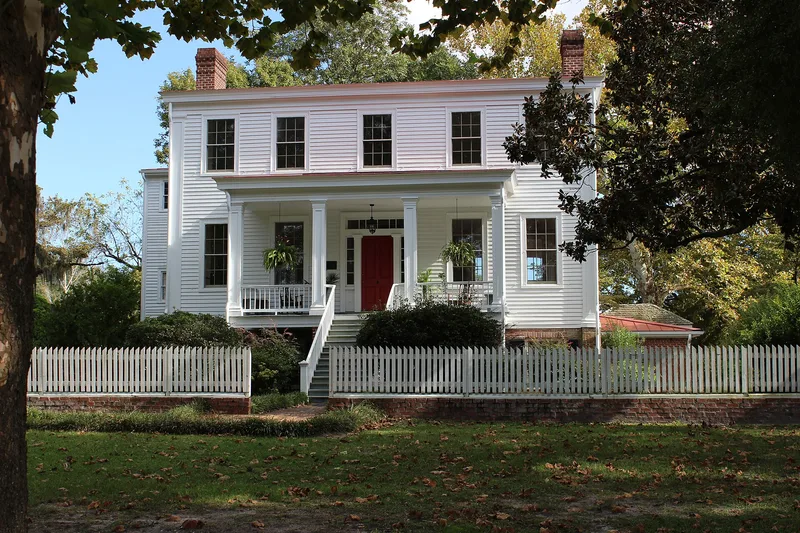
Poplar Grove is a two-story Greek Revival frame house at Scotts Hill in Pender County, set on a full brick basement among live oaks and magnolias. Joseph M. Foy, a planter in what was then New Hanover County, had it built in the 1850s on the site of a plantation whose main tract covered 628 acres. The house has a tetrastyle front porch, a double-tiered rear porch joined to the lawn by an exterior stair, and a basement gallery beneath the front porch, features the nomination links to the hot, humid coastal climate. Its interior has four rooms per floor around a central hall, with plaster medallions and Doric-pilastered mantels on the first floor. The property is significant for its architecture as a notable example of a coastal plantation house and for its ties to the Foy family, including Joseph T. Foy, who served in the state senate and house and helped promote the Onslow and East Carolina Railroad.
Significance in brief: The nomination argues the house is an impressive and little altered example of a coastal North Carolina plantation house that adapts Wilmington building traditions to a rural setting. Its high basement and double-tiered rear porch with exterior stair are presented as regional responses to a hot, humid climate. It is also associated with the Foy family, including Joseph M. Foy, a planter and Unionist, and his son Joseph T. Foy, a businessman and politician.
Machine-generated summary. This summary was generated by a language model from the official nomination document and has not been reviewed line by line by an editor. It may contain errors. Check the source document before relying on any detail. Source: nomination document (PDF) · National Archives catalog entry. NRHP reference 79003346, listed July 16, 1979. Summary generated October 2026 (model claude-haiku-5-5, prompt v1.1-2026-10-29, confidence high).
Key facts
| Address | US 17, Scotts Hill |
|---|---|
| County | Pender County |
| Listed | July 16, 1979 |
| Reference number | 79003346 |
| Resource type | Building |
| Period of significance | ca. 1850 |
| Architectural style | Greek Revival |
| Criteria |
|
| Areas of significance | Architecture, Social History |
| Level of significance | State |
| Status (as stated in the nomination) | The form states it is in excellent condition and that its landscaping has remained little changed; it is not stated to be occupied or vacant. |
| Acreage | 14.2 |
| Coordinates | 34.31971, -77.76583 (NPS GIS) |
What listing means for this property
National Register listing is honorary: it recognises significance and does not restrict what a private owner may do without federal money or permits. It unlocks the 20% federal rehabilitation tax credit for income-producing buildings, state credits in many states, and Section 106 review when federal agencies are involved. See what listing means in practice.
General information, not legal or tax advice. Rules change; confirm with your State Historic Preservation Office or a qualified adviser.
Sources and further reading
- National Park Service, National Register of Historic Places database (snapshot May 2026), reference 79003346.
- Nomination form (PDF, National Archives) — catalog entry
- Wikipedia article (used for cross-checking only; text not reproduced here)
- Wikidata Q18156913
- This listing as JSON
Last updated October 2026. Found an error? See the editorial policy for how to report it.