Cedar Grove Rural Crossroads Historic District

Why it's listed
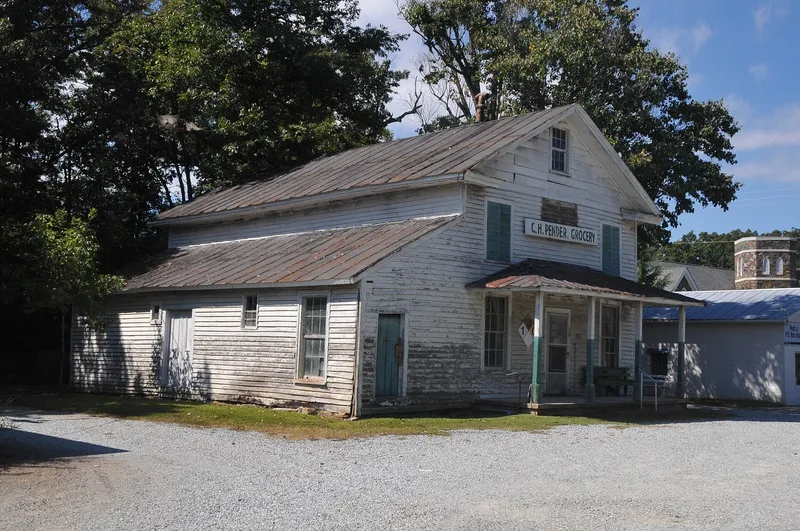
Cedar Grove is a rural crossroads community in northwest Orange County, grouped around the junction of two state roads and surrounded by pasture, cultivated fields, and woodland. The community began with a post office established around 1828, and by 1850 it had an academy, a tanner, a coachmaker, a doctor, and several shops. Stores, churches, a post office, and houses cluster at the intersection, while residences extend along the roads for about half a mile. The Allen A. Ellis Store, built in 1923, and the Allison-Oliver-Pender Store, operating since the 1880s, remain at the crossroads. The Cedar Grove Methodist Church, a Gothic Revival fieldstone building erected in 1939, and the Eno Presbyterian Church, a brick Gothic Revival building, anchor the district's north end. Its significance rests on the intact crossroads pattern, the field layout visible in aerial maps from 1938 and 1951, and a Black string band tradition that accompanied community dances until 1947.
Significance in brief: The nomination argues the district is a well-preserved example of a once-common nineteenth-century rural crossroads community that served as a commercial and social centre for farm families. It also cites its agricultural landscape, Colonial Revival and vernacular buildings, and a role in Black string band music and square dances from about 1930 to 1947.
Machine-generated summary. This summary was generated by a language model from the official nomination document and has not been reviewed line by line by an editor. It may contain errors. Check the source document before relying on any detail. Source: nomination document (PDF) · National Archives catalog entry. NRHP reference 98000389, listed April 23, 1998. Summary generated October 2026 (model claude-haiku-5-5, prompt v1.1-2026-10-29, confidence medium).
Key facts
| Address | Roughly along Carr Store Rd. and Efland-Cedar Grove Rd., Cedar Grove |
|---|---|
| County | Orange County |
| Listed | April 23, 1998 |
| Reference number | 98000389 |
| Resource type | District |
| Period of significance | Early nineteenth-century-1947 |
| Architectural style | Colonial Revival; Gothic Revival; Late Victorian; Mid-19th Century |
| Criteria |
|
| Areas of significance | Agriculture, Architecture, Black, Community Planning and Development, Social History |
| Level of significance | Local |
| Status (as stated in the nomination) | Several businesses ceased operation in 1923 and 1943; the Allison-Oliver-Pender Store continues to operate and sells gasoline. |
| Acreage | 125 |
| Coordinates | 36.17045, -79.16945 (NPS GIS) |
What listing means for this property
This is a historic district. Buildings within its boundary are either contributing (they add to the district's significance) or non-contributing. Owners of contributing income-producing buildings can claim the 20% federal rehabilitation tax credit; homeowners should look at state credits. National Register districts impose no design review by themselves; a local historic district ordinance, if one exists, does (the difference explained).
General information, not legal or tax advice. Rules change; confirm with your State Historic Preservation Office or a qualified adviser.
Sources and further reading
- National Park Service, National Register of Historic Places database (snapshot May 2026), reference 98000389.
- Nomination form (PDF, National Archives) — catalog entry
- Wikipedia article (used for cross-checking only; text not reproduced here)
- Wikidata Q19600684
- This listing as JSON
Last updated October 2026. Found an error? See the editorial policy for how to report it.