Pelletier House and Wantland Spring

Why it's listed
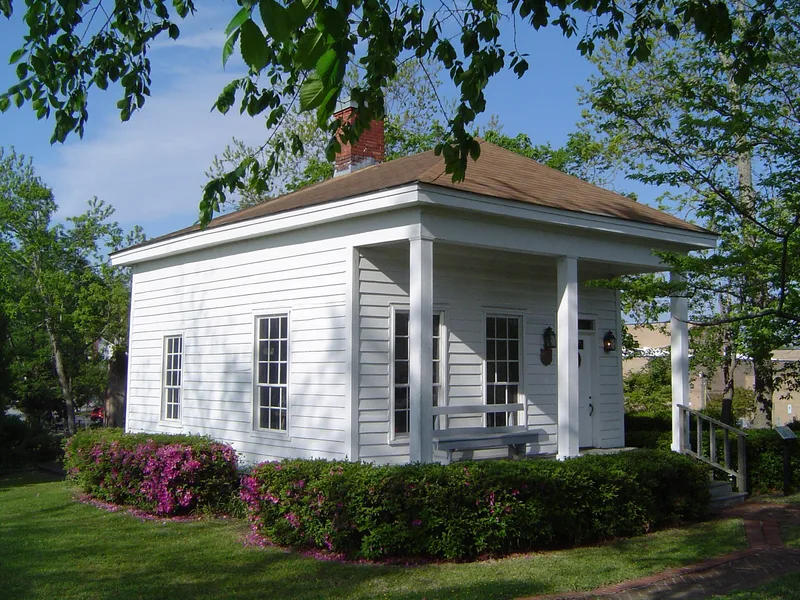
Perched on a bluff above the New River in downtown Jacksonville, this small one-story Greek Revival building was probably put up in the 1850s as an office and bachelor quarters for merchant Rufus Pelletier. It has a hipped roof that covers a front porch, a central brick chimney with two original mantels, and nine-over-six windows. Below the bluff flows Wantland Spring, which helped determine the 1753 location of the county courthouse and later served a turpentine distillery operated by William Pelletier and partners until it burned in 1851. Rufus Pelletier later served as postmaster and magistrate and added wings for his family, which burned in the late 1950s. The Onslow County Historical Society bought the property in 1957 and restored the house in the 1970s. It was recognized as the oldest building in Jacksonville and as a rare surviving local example of Greek Revival design, with the spring adding historic and landscape value.
Significance in brief: The nomination argues the house is the oldest building in Jacksonville and one of a small group of surviving Greek Revival buildings in Onslow County. It is tied to the Pelletier family's commercial and postal activities. Wantland Spring influenced the 1753 siting of the county courthouse and the later development of a waterfront distillery.
Machine-generated summary. This summary was generated by a language model from the official nomination document and has not been reviewed line by line by an editor. It may contain errors. Check the source document before relying on any detail. Source: nomination document (PDF) · National Archives catalog entry. NRHP reference 89001852, listed November 13, 1989. Summary generated October 2026 (model claude-sonnet-5-5, prompt v1.0-2026-10-29, confidence high).
Key facts
| Address | Old Bridge St. at New River, Jacksonville |
|---|---|
| County | Onslow County |
| Listed | November 13, 1989 |
| Reference number | 89001852 |
| Resource type | District |
| Period of significance | 1850s - ca. 1900 |
| Architect / builder | Unknown (probably built by Rufus Ferrand Pelletier or his brother William Pelletier) |
| Architectural style | Greek Revival |
| Criteria |
|
| Areas of significance | Commerce, Architecture |
| Level of significance | Local |
| Status (as stated in the nomination) | Owned since 1957 by the Onslow County Historical Society, restored in the 1970s and used as a museum and for society gatherings; the spring area was improved in 1961 and incorporated into a riverside park in 1986. |
| Acreage | 0.4 |
| Coordinates | 34.75160, -77.43352 (NPS GIS) |
What listing means for this property
This is a historic district. Buildings within its boundary are either contributing (they add to the district's significance) or non-contributing. Owners of contributing income-producing buildings can claim the 20% federal rehabilitation tax credit; homeowners should look at state credits. National Register districts impose no design review by themselves; a local historic district ordinance, if one exists, does (the difference explained).
General information, not legal or tax advice. Rules change; confirm with your State Historic Preservation Office or a qualified adviser.
Sources and further reading
- National Park Service, National Register of Historic Places database (snapshot May 2026), reference 89001852.
- Nomination form (PDF, National Archives) — catalog entry
- Wikipedia article (used for cross-checking only; text not reproduced here)
- Wikidata Q14708137
- This listing as JSON
Last updated October 2026. Found an error? See the editorial policy for how to report it.