Palo Alto Plantation

Why it's listed
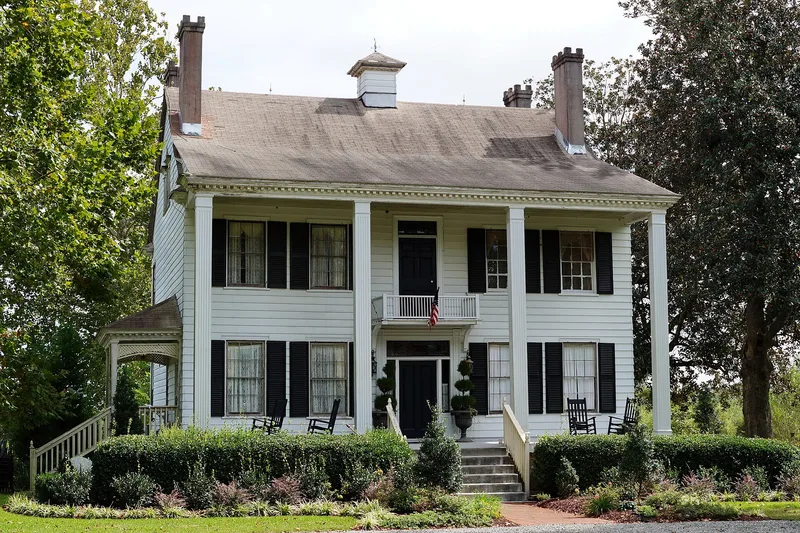
Palo Alto Plantation is a two-story frame house in Palopato, Onslow County, North Carolina. It has a five-bay symmetrical front, a full-height porch under the main gable roof, paired interior end chimneys, a central cupola and Palladian windows in the gables. Federal-style modillion and dentil cornices mix with simple Greek Revival doors and trim. The house is one of the few antebellum plantation houses left in the county. David W. Sanders, traditionally credited with building it, expanded the estate to 9,500 acres and 288 slaves, growing corn and cotton, and became one of the state's wealthiest planters. His grandson Daniel L. Russell, Jr., lived there as a boy and later served as governor. Union troops stripped the plantation during the Civil War, and the estate was later broken up. After decades of neglect and tenant use, the house was carefully renovated and again serves as a private residence.
Significance in brief: It is one of the few surviving antebellum plantation houses in Onslow County and was once the center of a 9,500-acre operation with 288 slaves, one of the largest in the state. It is tied to planter David W. Sanders and to his grandson Daniel L. Russell, Jr., governor of North Carolina from 1897 to 1901. Its architecture blends regional coastal forms, including a full-height porch, with Federal and Greek Revival detail.
Machine-generated summary. This summary was generated by a language model from the official nomination document and has not been reviewed line by line by an editor. It may contain errors. Check the source document before relying on any detail. Source: nomination document (PDF) · National Archives catalog entry. NRHP reference 79003338, listed October 10, 1979. Summary generated October 2026 (model claude-sonnet-5-5, prompt v1.0-2026-10-29, confidence high).
Key facts
| Address | SR 1434, Palopato |
|---|---|
| County | Onslow County |
| Listed | October 10, 1979 |
| Reference number | 79003338 |
| Resource type | Building |
| Architect / builder | Builder uncertain; probably William L. Hill or David W. Sanders (traditionally credited to Sanders) |
| Architectural style | Federal and Greek Revival details on a regional vernacular form |
| Criteria |
|
| Areas of significance | Agriculture, Architecture |
| Level of significance | State |
| Status (as stated in the nomination) | Restored after a long period of deterioration; in good condition and occupied as a private residence in a rural, agricultural setting. |
| Acreage | 25 |
| Coordinates | 34.80018, -77.21381 (NPS GIS) |
What listing means for this property
National Register listing is honorary for a privately owned home: it does not by itself restrict what an owner may do with their own money, and it does not require public access. Restrictions come from local landmark or historic-district ordinances, which are separate (how they differ).
Owner-occupied houses are not eligible for the 20% federal rehabilitation tax credit, which applies to income-producing buildings, but many states offer credits for homeowners. Listing also opens the door to preservation easements and to buying a plaque. Start with what listing means for homeowners, renovating a listed house and selling one.
General information, not legal or tax advice. Rules change; confirm with your State Historic Preservation Office or a qualified adviser.
Sources and further reading
- National Park Service, National Register of Historic Places database (snapshot May 2026), reference 79003338.
- Nomination form (PDF, National Archives) — catalog entry
- Wikipedia article (used for cross-checking only; text not reproduced here)
- Wikidata Q19987446
- This listing as JSON
Last updated October 2026. Found an error? See the editorial policy for how to report it.