Jugtown Pottery

Why it's listed
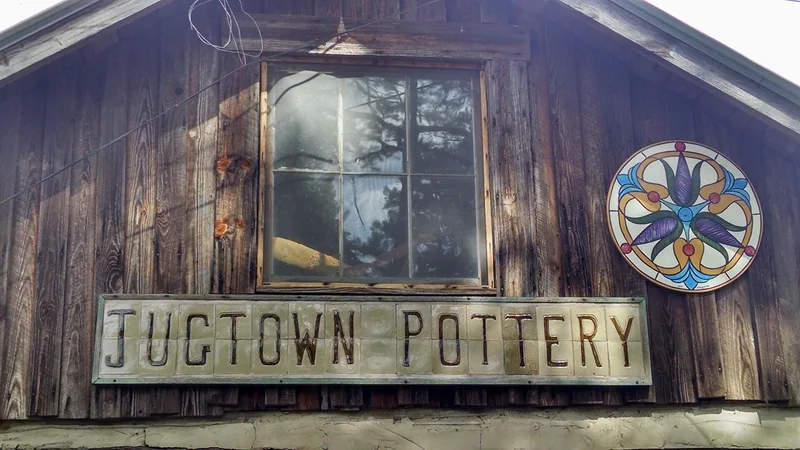
Jugtown Pottery is a rural pottery compound on about twelve wooded acres near Seagrove in Moore County, North Carolina. Raleigh artists Jacques and Juliana Busbee founded it about 1921 to revive traditional North Carolina pottery, blending local forms with Oriental ceramic traditions. Local farmer Henry Scott and his sons built the original log sales room, turning room, frame glaze room and a log dogtrot house about 1924. Two brick groundhog kilns and a mule-powered clay pug mill remain from the early years. Master potter Ben Owen worked here from 1923 to 1959, and the pottery earned an international reputation. Later operators, including a nonprofit group and potter Vernon Owens, added newer outbuildings and moved in two log tobacco barns, yet the older buildings remain on their original sites and carefully preserved. The pottery is judged significant for its role in North Carolina craft history, its associations with the Busbees and Owen, and its intact vernacular log architecture.
Significance in brief: The nomination argues for statewide significance under Criterion A as the best-preserved pottery in the eastern piedmont and one of North Carolina's most important traditional pottery centers. It qualifies under Criterion B for its ties to Jacques and Juliana Busbee and master potter Ben Owen. It has local architectural significance as a well-preserved compound of 1920s traditional log buildings.
Machine-generated summary. This summary was generated by a language model from the official nomination document and has not been reviewed line by line by an editor. It may contain errors. Check the source document before relying on any detail. Source: nomination document (PDF) · National Archives catalog entry. NRHP reference 99001284, listed November 12, 1999. Summary generated October 2026 (model claude-sonnet-5-5, prompt v1.0-2026-10-29, confidence high).
Key facts
| Address | 330 Jugtown Rd., Seagrove |
|---|---|
| County | Moore County |
| Listed | November 12, 1999 |
| Reference number | 99001284 |
| Resource type | Building |
| Period of significance | ca.1921-1959 |
| Architect / builder | Scott, Henry |
| Architectural style | Other: log construction |
| Criteria |
|
| Areas of significance | Art, Architecture |
| Level of significance | Local |
| Status (as stated in the nomination) | Still a working pottery; the original sales room, turning room, glaze room, kilns and house all still stand and are in use. The small 1970s cabin is unused. |
| Acreage | 12 |
| Coordinates | 35.50762, -79.65147 (NPS GIS) |
What listing means for this property
National Register listing is honorary: it recognises significance and does not restrict what a private owner may do without federal money or permits. It unlocks the 20% federal rehabilitation tax credit for income-producing buildings, state credits in many states, and Section 106 review when federal agencies are involved. See what listing means in practice.
General information, not legal or tax advice. Rules change; confirm with your State Historic Preservation Office or a qualified adviser.
Sources and further reading
- National Park Service, National Register of Historic Places database (snapshot May 2026), reference 99001284.
- Nomination form (PDF, National Archives) — catalog entry
- Wikipedia article (used for cross-checking only; text not reproduced here)
- Wikidata Q6307777
- This listing as JSON
Last updated October 2026. Found an error? See the editorial policy for how to report it.