Dellinger Mill
Dellinger Mill is a building in Hawk, Mitchell County, North Carolina, listed on the National Register of Historic Places on November 19, 1998 (reference number 98001385). The National Park Service records its significance in Architecture and Social History at the state level.
Facts from the NPS National Register database (); nomination summary October 2026. Last updated . Sources for each fact.

Approximate location: the National Park Service places this pin arbitrarily within the property, not at a surveyed point (stated accuracy ±12 m).
Why it's listed
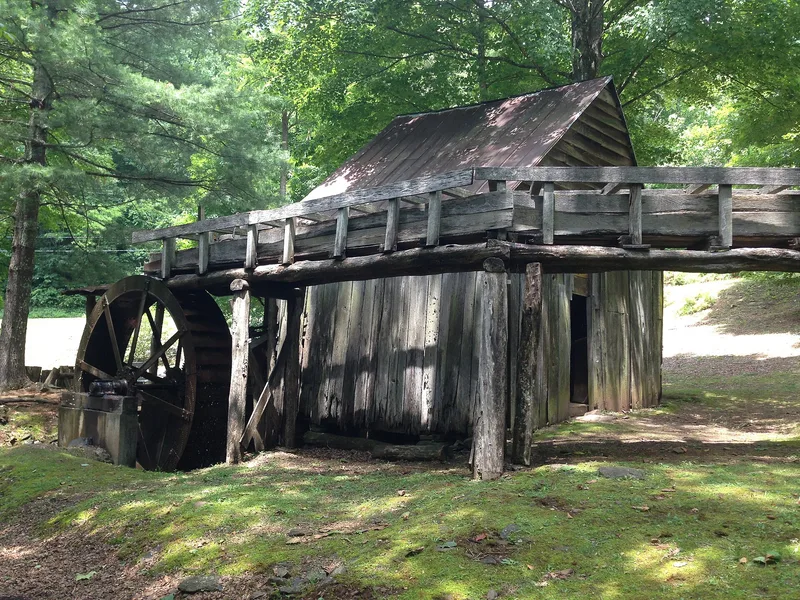
A small unpainted frame gristmill built ca. 1901-1903 on the north bank of Cane Creek near Hawk, Mitchell County, North Carolina, by David R. Philip Dellinger after a spring flood destroyed his father Reuben Dellinger's earlier mill. Built of chestnut felled on family land, it has a water wheel of iron made by the Fitz Water Wheel Company, with its original millstones and drive system still in place. The mill ground corn for family and neighbors under a toll of one-tenth of a bushel until 1955, and it was not converted to electricity despite power reaching the valley in the late 1920s. The site also includes a sawmill shed, a stone molasses furnace, earthen millraces, stone walls of a former barnyard, and a frame apple house used to store fruit and other farm products. The property is regarded as the only known intact water-powered grist mill of its type in North Carolina, and it is significant for its architecture and for what it shows of rural self-sufficiency in the mountains.
Significance in brief: The nomination argues the mill holds statewide significance in architecture and social history. It survives with its original milling equipment, including the water wheel and millstones, and operated as a water-powered grist mill until 1955. The document states it is the only known intact water-powered grist mill of its type in North Carolina, and says the site reflects the self-sufficiency of rural family life in western North Carolina.
Machine-generated summary. This summary was generated by a language model from the official nomination document and has not been reviewed line by line by an editor. It may contain errors. Check the source document before relying on any detail. Source: nomination document (PDF) · National Archives catalog entry. NRHP reference 98001385, listed November 19, 1998. Summary generated October 2026 (model claude-haiku-5-5, prompt v1.1-2026-10-29, confidence medium).
Key facts
| Official database NPS National Register database, ref. 98001385 , checked | |
|---|---|
| Address | S side of Cane Creek Rd., just W of jct. with NC 1239, Hawk |
| County | Mitchell County |
| Listed | November 19, 1998 |
| Reference number | 98001385 |
| Resource type | Building |
| Areas of significance | Architecture, Social History |
| Level of significance | State |
| National Historic Landmark | No |
| Acreage | 3.6 |
| Official document, machine-extracted Nomination form (National Archives) , checked | |
| Period of significance | Ca. 1901-1936 |
| Architect / builder | David R. Philip Dellinger (builder) |
| Architectural style | No style |
| Criteria |
|
| Status (as stated in the nomination) | Water-powered operation ended in 1955; the apple house is deteriorated but structurally sound and was to be restored as part of the mill restoration project. |
| Official dataset NPS cultural-resource GIS (NRHP locations) | |
| Coordinates | 36.01693, -82.09803 |
What listing means for this property
For an income-producing building, listing (individually or as a contributing building in a district) is the gateway to the 20% federal rehabilitation tax credit on qualified rehabilitation costs, often stackable with state credits. Work claiming the credit must follow the Secretary of the Interior's Standards and be approved in advance.
Listing does not restrict a private owner acting without federal money or permits; where federal funding or licensing is involved, Section 106 review applies.
General information, not legal or tax advice. Rules change; confirm with your State Historic Preservation Office or a qualified adviser.
Questions about Dellinger Mill
When was Dellinger Mill added to the National Register of Historic Places?
Dellinger Mill was listed on November 19, 1998. Its National Register reference number is 98001385.
Is Dellinger Mill a National Historic Landmark?
No. The National Park Service database (snapshot of May 2026) lists Dellinger Mill on the National Register but does not record it as a National Historic Landmark.
Where is Dellinger Mill?
S side of Cane Creek Rd., just W of jct. with NC 1239, Hawk, Mitchell County, North Carolina; coordinates 36.01693, -82.09803.
Why is Dellinger Mill historically significant?
According to a machine-generated summary of its nomination form: The nomination argues the mill holds statewide significance in architecture and social history. It survives with its original milling equipment, including the water wheel and millstones, and operated as a water-powered grist mill until 1955. The document states it is the only known intact water-powered grist mill of its type in North Carolina, and says the site reflects the self-sufficiency of rural family life in western North Carolina. Check the nomination document before relying on any detail.
Who designed or built Dellinger Mill?
The nomination form names David R. Philip Dellinger (builder) as architect or builder (extracted by machine from the nomination; check the source document).
Where can I read the original nomination for Dellinger Mill?
The nomination form is a public record held by the National Archives: nomination document (PDF).
Sources and further reading
- National Park Service, National Register of Historic Places database (snapshot May 2026), reference 98001385.
- Nomination form (PDF, National Archives) — catalog entry
- Wikipedia article (used for cross-checking only; text not reproduced here)
- Wikidata Q19461317
- This listing as JSON
Last updated November 2026. Found an error? See the editorial policy for how to report it.