Latta House

Why it's listed
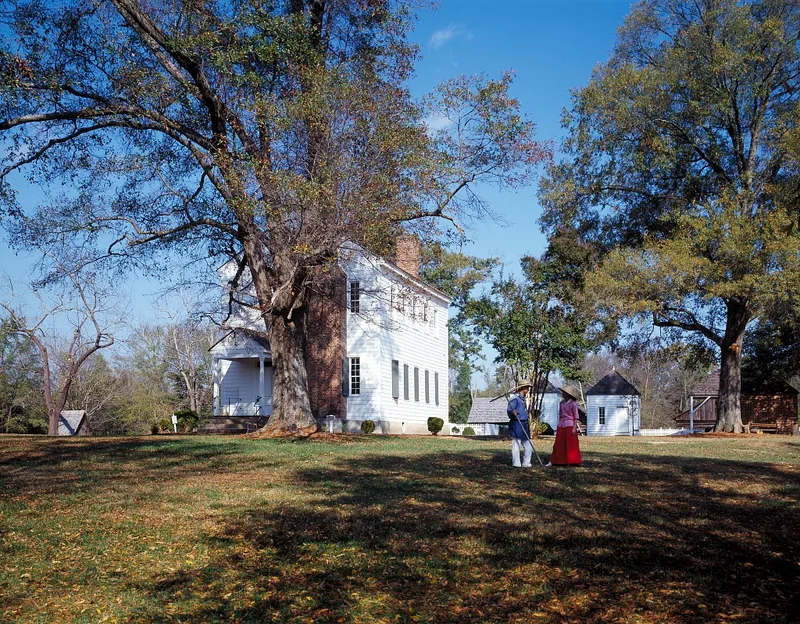
Built about 1800 by James Latta, a traveling merchant and planter who emigrated from Ireland in 1785, this two-story frame house sits on land he bought in 1799 on the east side of the Catawba River. It has beaded weatherboards, a low stone foundation, and Flemish bond brick chimneys at each gable end. The main entrance is unusually placed on the narrow south end, and the plan features a wide side hall with two rooms beside it. Inside, an open-string stair with a Georgian-style balustrade and wave brackets stands out, along with elaborate mantels carrying guilloche, lozenge and Wall of Troy ornament. A smokehouse with a pyramidal roof survives nearby. After Latta's death in 1837 the property passed through the Sample family, then to power companies in the twentieth century. It is valued as an early Federal house with a plan unique for its period in North Carolina and among the best in the upper Piedmont.
Significance in brief: The nomination calls it an especially interesting early Federal house with a floor plan unique for its period in North Carolina. Its Georgian-influenced stair, elaborate mantels and consistent graceful Federal detailing make it one of the best of its period in the upper Piedmont.
Machine-generated summary. This summary was generated by a language model from the official nomination document and has not been reviewed line by line by an editor. It may contain errors. Check the source document before relying on any detail. Source: nomination document (PDF) · National Archives catalog entry. NRHP reference 72000978, listed March 16, 1972. Summary generated October 2026 (model claude-sonnet-5-5, prompt v1.0-2026-10-29, confidence high).
Key facts
| Address | 6 mi. S of Huntersville on SR 2125, Huntersville |
|---|---|
| County | Mecklenburg County |
| Listed | March 16, 1972 |
| Reference number | 72000978 |
| Resource type | Building |
| Period of significance | 19th Century |
| Architect / builder | James Latta (builder) |
| Architectural style | Early Federal |
| Areas of significance | Architecture |
| Level of significance | Local |
| Status (as stated in the nomination) | Listed in good condition and unoccupied; the land, but not the use of the house, was leased to the United States government until June 30, 1975. |
| Acreage | 0.8 |
| Coordinates | 35.35458, -80.93119 (NPS GIS) |
What listing means for this property
National Register listing is honorary for a privately owned home: it does not by itself restrict what an owner may do with their own money, and it does not require public access. Restrictions come from local landmark or historic-district ordinances, which are separate (how they differ).
Owner-occupied houses are not eligible for the 20% federal rehabilitation tax credit, which applies to income-producing buildings, but many states offer credits for homeowners. Listing also opens the door to preservation easements and to buying a plaque. Start with what listing means for homeowners, renovating a listed house and selling one.
Noted as vacant in the nomination. Nomination documents can be decades old; current status may differ. If you are considering buying an empty listed property, read the due-diligence checklist.
General information, not legal or tax advice. Rules change; confirm with your State Historic Preservation Office or a qualified adviser.
Sources and further reading
- National Park Service, National Register of Historic Places database (snapshot May 2026), reference 72000978.
- Nomination form (PDF, National Archives) — catalog entry
- Wikipedia article (used for cross-checking only; text not reproduced here)
- Wikidata Q14708013
- This listing as JSON
Last updated October 2026. Found an error? See the editorial policy for how to report it.