Hayes-Byrum Store and House
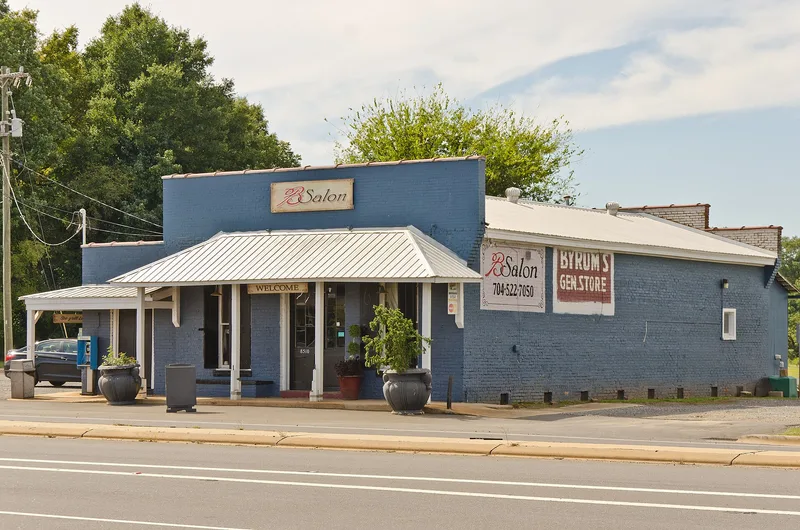

Why it's listed
Built about 1890 at the Shopton crossroads on Steele Creek Road in rural Mecklenburg County, North Carolina, the Hayes-Byrum Store is a one-story brick building with load-bearing walls in common bond, and it is regarded as the county's oldest surviving rural commercial building. Joseph Rufus Hayes built it to serve the farming families of the Steele Creek area, and the Shopton Post Office was later housed in it. The store keeps original features including bracketed wooden shelves with pendants inside. Next to it stands a house built about 1900 in the Queen Anne style, a two-story frame dwelling with a wraparound veranda, a cutaway bay, and original Tuscan porch columns. Its parlor mantel with free-standing colonettes is the house's only classical mantel. The store and house are listed for their architecture, the store as a rare surviving country general store and the house as one of the county's few relatively intact Queen Anne examples.
Significance in brief: The store is described as the oldest surviving commercial building in rural Mecklenburg County and retains many original exterior and interior elements. The house is regarded as a relatively intact example of the Queen Anne style in rural Mecklenburg County, with original woodwork and a classical mantel and porch columns. Together they are presented as key elements of the Shopton crossroads community.
Machine-generated summary. This summary was generated by a language model from the official nomination document and has not been reviewed line by line by an editor. It may contain errors. Check the source document before relying on any detail. Source: nomination document (PDF) · National Archives catalog entry. NRHP reference 90002186, listed January 31, 1991. Summary generated October 2026 (model claude-haiku-5-5, prompt v1.1-2026-10-29, confidence medium).
Key facts
| Address | NC 160 S of jct. with Shopton Rd., Charlotte |
|---|---|
| County | Mecklenburg County |
| Listed | January 31, 1991 |
| Reference number | 90002186 |
| Resource type | District |
| Period of significance | ca. 1890-1900 |
| Architectural style | Queen Anne; vernacular commercial |
| Criteria |
|
| Areas of significance | Architecture |
| Level of significance | Local |
| Status (as stated in the nomination) | The store remains in operation selling foodstuffs and general merchandise; the house is occupied by the owner. |
| Acreage | 1.2 |
| Coordinates | 35.17016, -80.96301 (NPS GIS) |
What listing means for this property
This is a historic district. Buildings within its boundary are either contributing (they add to the district's significance) or non-contributing. Owners of contributing income-producing buildings can claim the 20% federal rehabilitation tax credit; homeowners should look at state credits. National Register districts impose no design review by themselves; a local historic district ordinance, if one exists, does (the difference explained).
General information, not legal or tax advice. Rules change; confirm with your State Historic Preservation Office or a qualified adviser.
Sources and further reading
- National Park Service, National Register of Historic Places database (snapshot May 2026), reference 90002186.
- Nomination form (PDF, National Archives) — catalog entry
- Wikipedia article (used for cross-checking only; text not reproduced here)
- Wikidata Q19462245
- This listing as JSON
Last updated October 2026. Found an error? See the editorial policy for how to report it.