Old Fort Commercial Historic District

Why it's listed
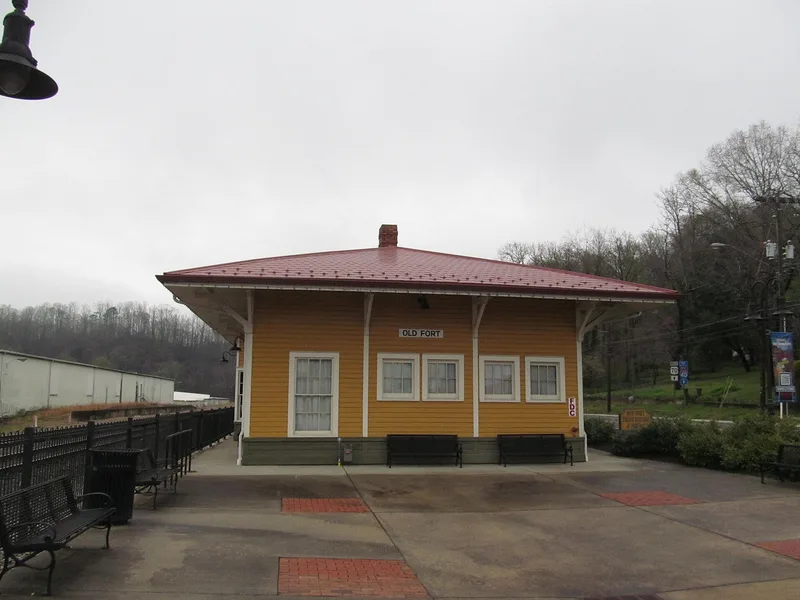
Old Fort's downtown core is a compact district of about nine and one-half acres along East Main Street and Catawba Avenue. It contains eleven contributing buildings, a railroad depot, and an arrowhead monument, most of them one- and two-story brick or concrete block commercial structures with flat roofs, parapets, corbelled cornices and segmental-arched upper windows. Styles range from Italianate and Commercial Style to an Art Moderne movie theater at 66 East Main Street. Uses over time included banks, drugstores, department and hardware stores, restaurants, a post office and a car dealership. The town grew around the railroad, which reached Old Fort in 1867 and stopped there until the line over the mountain was finished in 1879. The present depot dates to 1894. The district developed through 1960 and retains the look of a small mountain-town business center, despite some replaced buildings and altered storefronts.
Significance in brief: The district is significant for its role in the commercial and transportation history of Old Fort, which grew with the railroad. The current depot was built in 1894, and the district continued to develop through 1960 as businesses thrived. Architecturally, it shows late nineteenth-century Italianate-influenced buildings alongside early twentieth-century commercial buildings and a 1940s Art Moderne theater.
Machine-generated summary. This summary was generated by a language model from the official nomination document and has not been reviewed line by line by an editor. It may contain errors. Check the source document before relying on any detail. Source: nomination document (PDF) · National Archives catalog entry. NRHP reference 11000257, listed April 29, 2011. Summary generated October 2026 (model claude-sonnet-5-5, prompt v1.0-2026-10-29, confidence medium).
Key facts
| Address | Roughly bounded by E. Main, Spring, Commerce & W. Main Sts., Old Fort |
|---|---|
| County | McDowell County |
| Listed | April 29, 2011 |
| Reference number | 11000257 |
| Resource type | District |
| Period of significance | 1894-1960 |
| Architectural style | Commercial Style, Italianate, Romanesque Revival, Art Moderne |
| Areas of significance | Architecture, Commerce, Transportation |
| Level of significance | Local |
| Status (as stated in the nomination) | Retains architectural integrity despite the loss of a few historic buildings and minor alterations. Current uses include banks, shops, restaurants, a meeting hall, a museum and public works. |
| Acreage | 9.5 |
| Coordinates | 35.63062, -82.18172 (NPS GIS) |
What listing means for this property
This is a historic district. Buildings within its boundary are either contributing (they add to the district's significance) or non-contributing. Owners of contributing income-producing buildings can claim the 20% federal rehabilitation tax credit; homeowners should look at state credits. National Register districts impose no design review by themselves; a local historic district ordinance, if one exists, does (the difference explained).
General information, not legal or tax advice. Rules change; confirm with your State Historic Preservation Office or a qualified adviser.
Sources and further reading
- National Park Service, National Register of Historic Places database (snapshot May 2026), reference 11000257.
- Nomination form (PDF, National Archives) — catalog entry
- Wikipedia article (used for cross-checking only; text not reproduced here)
- Wikidata Q19987377
- This listing as JSON
Last updated October 2026. Found an error? See the editorial policy for how to report it.