Sunnybank
Also known as: The Inn at Hot Springs
Sunnybank is a building in Hot Springs, Madison County, North Carolina, listed on the National Register of Historic Places on May 23, 1980 (reference number 80002883). The National Park Service records its significance in Architecture and Performing Arts at the local level.
Facts from the NPS National Register database (); nomination summary October 2026. Last updated . Sources for each fact.

Approximate location: the National Park Service places this pin arbitrarily within the property, not at a surveyed point (stated accuracy ±12 m).
Why it's listed
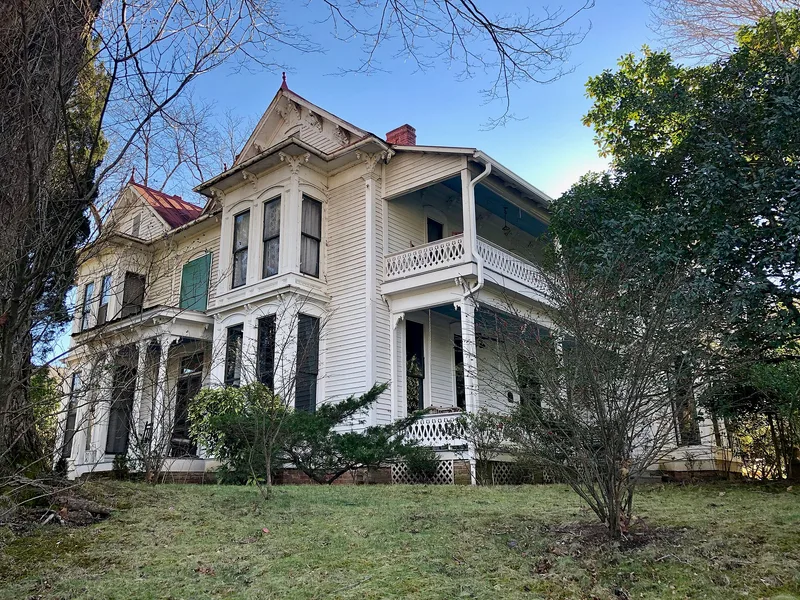
Sunnybank is a large, irregular frame house on a one-acre lawn overlooking Hot Springs, North Carolina. Built about 1875 for Charles D. Merritt, a wealthy northerner, it served as a summer residence during the town's peak as a fashionable mineral-springs resort. Its weatherboard walls, intersecting gables, sawn brackets, two-story porches and well-preserved interior millwork reflect Victorian tastes, and it is the only summer house from that decade in town to survive essentially intact. Later owners included Colonel J. H. Rumbough and the family of Frances Shaw. From 1912 it operated as a boardinghouse, and in 1919 it passed to the Gentry family. Jane Gentry sang sixty-four ballads that English folklorist Cecil Sharp collected in 1916, and her daughter Maude Gentry Long was recorded by the Library of Congress. German internees' wives boarded here during the First World War. It continues to take guests today, linking the town's resort past to its present.
Significance in brief: It is the last major surviving reminder of Hot Springs' nineteenth-century resort heyday and the only 1870s summer house there to survive essentially intact. It is associated with Jane Gentry and Maude Gentry Long, whose ballads were collected by Cecil Sharp and recorded by the Library of Congress. It also stands as a largely unaltered example of late Victorian mountain resort architecture.
Machine-generated summary. This summary was generated by a language model from the official nomination document and has not been reviewed line by line by an editor. It may contain errors. Check the source document before relying on any detail. Source: nomination document (PDF) · National Archives catalog entry. NRHP reference 80002883, listed May 23, 1980. Summary generated October 2026 (model claude-sonnet-5-5, prompt v1.0-2026-10-29, confidence high).
Key facts
| Official database NPS National Register database, ref. 80002883 , checked | |
|---|---|
| Address | NC 209 and Walnut St., Hot Springs |
| County | Madison County |
| Listed | May 23, 1980 |
| Reference number | 80002883 |
| Resource type | Building |
| Areas of significance | Architecture, Performing Arts |
| Level of significance | Local |
| National Historic Landmark | No |
| Acreage | 1 |
| Official document, machine-extracted Nomination form (National Archives) , checked | |
| Period of significance | 1800-1899 |
| Architect / builder | Unknown |
| Architectural style | Italianate Revival-derived ornament on a rambling, irregular Victorian frame house |
| Criteria |
|
| Status (as stated in the nomination) | Occupied and in use as an inn offering rooms and meals; the owner was carrying out repairs and rehabilitation at the time of nomination. |
| Official dataset NPS cultural-resource GIS (NRHP locations) | |
| Coordinates | 35.89137, -82.82967 |
What listing means for this property
National Register listing is honorary: it recognises significance and does not restrict what a private owner may do without federal money or permits. It unlocks the 20% federal rehabilitation tax credit for income-producing buildings, state credits in many states, and Section 106 review when federal agencies are involved. See what listing means in practice.
General information, not legal or tax advice. Rules change; confirm with your State Historic Preservation Office or a qualified adviser.
Questions about Sunnybank
When was Sunnybank added to the National Register of Historic Places?
Sunnybank was listed on May 23, 1980. Its National Register reference number is 80002883.
Is Sunnybank a National Historic Landmark?
No. The National Park Service database (snapshot of May 2026) lists Sunnybank on the National Register but does not record it as a National Historic Landmark.
Where is Sunnybank?
NC 209 and Walnut St., Hot Springs, Madison County, North Carolina; coordinates 35.89137, -82.82967.
Why is Sunnybank historically significant?
According to a machine-generated summary of its nomination form: It is the last major surviving reminder of Hot Springs' nineteenth-century resort heyday and the only 1870s summer house there to survive essentially intact. It is associated with Jane Gentry and Maude Gentry Long, whose ballads were collected by Cecil Sharp and recorded by the Library of Congress. It also stands as a largely unaltered example of late Victorian mountain resort architecture. Check the nomination document before relying on any detail.
Who designed or built Sunnybank?
The nomination form names Unknown as architect or builder (extracted by machine from the nomination; check the source document).
Where can I read the original nomination for Sunnybank?
The nomination form is a public record held by the National Archives: nomination document (PDF).
Sources and further reading
- National Park Service, National Register of Historic Places database (snapshot May 2026), reference 80002883.
- Nomination form (PDF, National Archives) — catalog entry
- Wikipedia article (used for cross-checking only; text not reproduced here)
- Wikidata Q25203150
- This listing as JSON
Last updated November 2026. Found an error? See the editorial policy for how to report it.