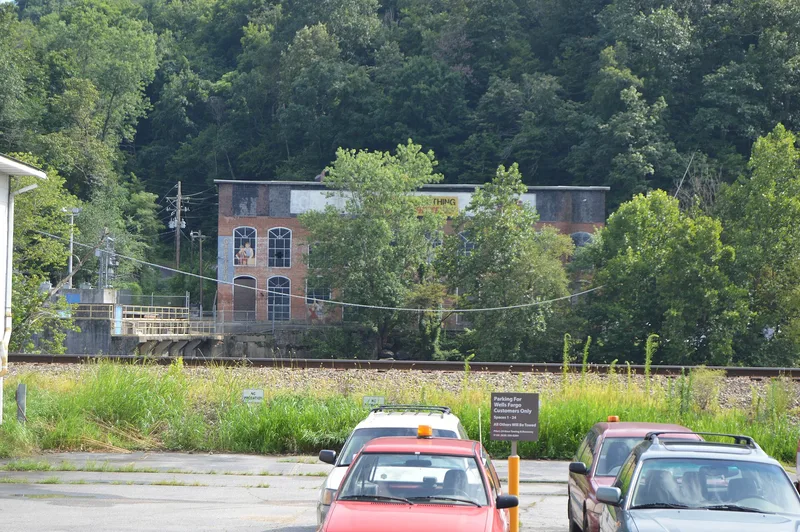
Capitola Manufacturing Company Cotton Yarn Mill
Also known as: Marshall Mill and Power company
Capitola Manufacturing Company Cotton Yarn Mill is a building in Marshall, Madison County, North Carolina, listed on the National Register of Historic Places on August 28, 2012 (reference number 12000577). The National Park Service records its significance in Industry at the local level.
Facts from the NPS National Register database (); nomination summary October 2026. Last updated . Sources for each fact.

Approximate location: the National Park Service places this pin arbitrarily within the property, not at a surveyed point (stated accuracy ±12 m).
Why it's listed
Built about 1905 on the south bank of the French Broad River at Marshall, North Carolina, the Capitola Manufacturing Company Cotton Yarn Mill was a spinning mill founded in 1903 by local investors led by W. J. McLendon, who gave the company his wife's name. The original building was two stories of solid brick with heavy timber interior posts and beams, powered first by a water wheel fed from a dam on the river. A third story was added by Marshall Mill and Power Company after it acquired the property in 1926, and the building was in place by 1928. The mill employed about 200 people at its start and was among the largest employers in the town through the 1920s. Its operation passed through a series of owners, tenants and leases after 1930, and it is recognized for its association with the industrial growth of Marshall in the early twentieth century.
Significance in brief: The nomination argues the mill is significant under Criterion A for industry because it was a major employer in Marshall through the first three decades of the twentieth century, in a town with few other manufacturing opportunities. It is presented as a contribution to the industrial and economic development of Marshall during North Carolina's cotton mill expansion. The mill's heavy-timber interior and its water-power history also form part of the case.
Machine-generated summary. This summary was generated by a language model from the official nomination document and has not been reviewed line by line by an editor. It may contain errors. Check the source document before relying on any detail. Source: nomination document (PDF) · National Archives catalog entry. NRHP reference 12000577, listed August 28, 2012. Summary generated October 2026 (model claude-haiku-5-5, prompt v1.1-2026-10-29, confidence medium).
Key facts
| Official database NPS National Register database, ref. 12000577 , checked | |
|---|---|
| Address | SE. end of Bridge No. 328 over French Broad R., Marshall |
| County | Madison County |
| Listed | August 28, 2012 |
| Reference number | 12000577 |
| Resource type | Building |
| Areas of significance | Industry |
| Level of significance | Local |
| National Historic Landmark | No |
| Acreage | 2.3 |
| Official document, machine-extracted Nomination form (National Archives) , checked | |
| Period of significance | ca. 1905-1930 |
| Architectural style | Other: heavy-timber mill construction |
| Criteria |
|
| Status (as stated in the nomination) | Continued in operation after 1930 under several owners and tenants, and the building is described as being in poor-to-altered condition with boarded and infilled windows. |
| Official dataset NPS cultural-resource GIS (NRHP locations) | |
| Coordinates | 35.79484, -82.68377 |
What listing means for this property
For an income-producing building, listing (individually or as a contributing building in a district) is the gateway to the 20% federal rehabilitation tax credit on qualified rehabilitation costs, often stackable with state credits. Work claiming the credit must follow the Secretary of the Interior's Standards and be approved in advance.
Listing does not restrict a private owner acting without federal money or permits; where federal funding or licensing is involved, Section 106 review applies.
General information, not legal or tax advice. Rules change; confirm with your State Historic Preservation Office or a qualified adviser.
Questions about Capitola Manufacturing Company Cotton Yarn Mill
When was Capitola Manufacturing Company Cotton Yarn Mill added to the National Register of Historic Places?
Capitola Manufacturing Company Cotton Yarn Mill was listed on August 28, 2012. Its National Register reference number is 12000577.
Is Capitola Manufacturing Company Cotton Yarn Mill a National Historic Landmark?
No. The National Park Service database (snapshot of May 2026) lists Capitola Manufacturing Company Cotton Yarn Mill on the National Register but does not record it as a National Historic Landmark.
Where is Capitola Manufacturing Company Cotton Yarn Mill?
SE. end of Bridge No. 328 over French Broad R., Marshall, Madison County, North Carolina; coordinates 35.79484, -82.68377.
Why is Capitola Manufacturing Company Cotton Yarn Mill historically significant?
According to a machine-generated summary of its nomination form: The nomination argues the mill is significant under Criterion A for industry because it was a major employer in Marshall through the first three decades of the twentieth century, in a town with few other manufacturing opportunities. It is presented as a contribution to the industrial and economic development of Marshall during North Carolina's cotton mill expansion. The mill's heavy-timber interior and its water-power history also form part of the case. Check the nomination document before relying on any detail.
Where can I read the original nomination for Capitola Manufacturing Company Cotton Yarn Mill?
The nomination form is a public record held by the National Archives: nomination document (PDF).
Sources and further reading
- National Park Service, National Register of Historic Places database (snapshot May 2026), reference 12000577.
- Nomination form (PDF, National Archives) — catalog entry
- Wikipedia article (used for cross-checking only; text not reproduced here)
- Wikidata Q19460836
- This listing as JSON
Last updated November 2026. Found an error? See the editorial policy for how to report it.