California Creek Missionary Baptist Church

Why it's listed
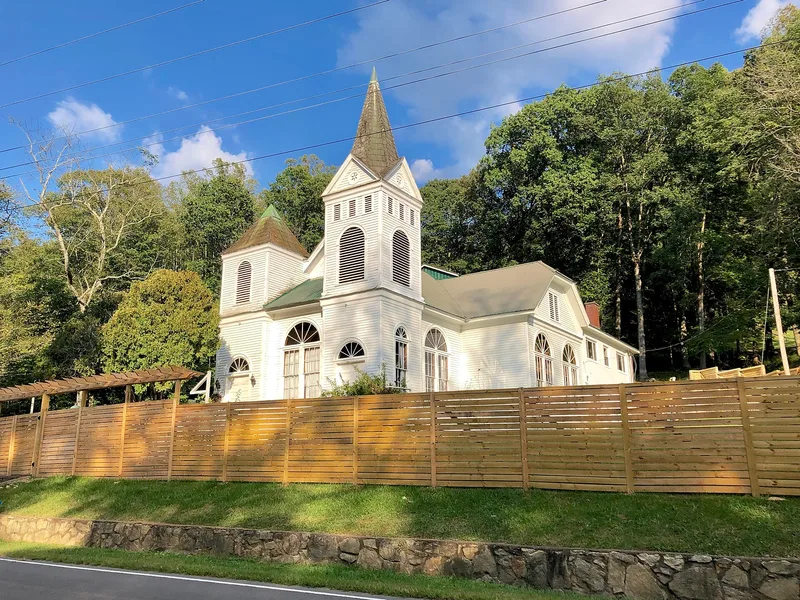
Four miles north of Mars Hill, beside US 23, stands a white frame country church built in 1917 by George Corn, who served as both architect and master builder. Its plan is cruciform and Gothic in form, with two corner towers of different heights, one ending in a pyramidal cap and the other in an octagonal spire. Colonial Revival details include round-arched fanlights over every door and window. Inside, unpainted beaded match board covers the walls and ceiling. The congregation, organized in 1869 and descended from local settler families, worshipped in a log building and a later 1876 church before building here. The highway project of 1937 moved the church back several feet, and a two-story brick Sunday school wing was added in 1954. The congregation moved to a newer building in 1976, and the old church now serves as a residence and restaurant. It was recognized for its size and architectural distinction among rural mountain chapels.
Significance in brief: The nomination argues the church is an unusually large and architecturally distinctive version of the common rural mountain chapel, with Gothic cruciform massing, asymmetrical corner towers and Colonial Revival details. It is also tied to the growing sophistication of the western North Carolina mountain population after the railroad arrived, and to the descendants of the original settlers who founded the congregation.
Machine-generated summary. This summary was generated by a language model from the official nomination document and has not been reviewed line by line by an editor. It may contain errors. Check the source document before relying on any detail. Source: nomination document (PDF) · National Archives catalog entry. NRHP reference 84002342, listed July 12, 1984. Summary generated October 2026 (model claude-sonnet-5-5, prompt v1.0-2026-10-29, confidence high).
Key facts
| Address | US 23, Mars Hill |
|---|---|
| County | Madison County |
| Listed | July 12, 1984 |
| Reference number | 84002342 |
| Resource type | Building |
| Period of significance | 1900- |
| Architect / builder | George Corn (architect and master builder) |
| Architectural style | Gothic cruciform form with Colonial Revival details |
| Criteria |
|
| Areas of significance | Architecture, Religion |
| Level of significance | State |
| Status (as stated in the nomination) | The congregation moved to a newer building in 1976 and sold the church in the late 1970s. It is now used as a private residence and roadside restaurant, and the 1954 brick Sunday school wing has been converted to an apartment. |
| Acreage | 0.9 |
| Coordinates | 35.87374, -82.51376 (NPS GIS) |
What listing means for this property
Religious properties are listed for their architectural or historical significance, not their religious use. Listing is honorary and does not restrict the congregation's use of the building. The federal rehabilitation credit is generally unavailable unless part of the building is income-producing; some state programmes and preservation grants do cover religious buildings. Federal funding or permits trigger Section 106 review.
General information, not legal or tax advice. Rules change; confirm with your State Historic Preservation Office or a qualified adviser.
Sources and further reading
- National Park Service, National Register of Historic Places database (snapshot May 2026), reference 84002342.
- Nomination form (PDF, National Archives) — catalog entry
- Wikipedia article (used for cross-checking only; text not reproduced here)
- Wikidata Q5020378
- This listing as JSON
Last updated October 2026. Found an error? See the editorial policy for how to report it.